From Scot McKnight:
Two final comments: first, we need to admit that we are all involved in covenant parth marking. Sometimes more severely than other times; some more than others; but each of us uses various behaviors to judge ourselves and others.
Second, there are only two "theories" of the Christian life that simply cannot be "marked." You won't be surprised by this, but they are (1) Jesus' use of the Jesus Creed: loving God and loving others. And, (2) Paul's use of the category of "life in the Spirit."
Here's why each is "unmarkable." Because Love is a response and a life that transcends the observable and life in the Spirit is as well. Who can say "I've got love down, give me a challenge" or "I'm always in the Spirit, anything else you want me to do?" These two are unmarkable in part because they are ongoing, responsive, and qualitative features of Christian existence. And they are both almost "unjudgeable": how can we really know if someone is loving? how can we know if someone is really "living in the Spirit"? Only by converting love and Spirit into "objectified" covenant path markers, and when we do that we slip out of the embrace of love and the Spirit.
Friday, June 10, 2005
Thursday, June 09, 2005
5 Minute Church
Driven by the efficiency and pragmatism of our culture, the institutional church has lowered the bar yet again. Forget discipleship. Forget "taking up your cross". Forget the Shema. Forget about being the Church. Just give us 5 minutes. . .
Although, for as much as I get out of a typical church service. . . 5 minutes might be just about right. . .
Although, for as much as I get out of a typical church service. . . 5 minutes might be just about right. . .
Wednesday, June 08, 2005
Historical Context of 1st Century Israel
I am reading "The New Testament and The People of God" by N.T. Wright. It's been very helpful to read the NT in light of the context in which it was lived out and written. I happened across this summary which seems to accurately describe what I've read so far:
"The Jews had, of course, returned to the land of Israel after the exile. But nowhere in all second-temple Jewish literature do we have the slightest suggestion that the great promises and prophecies of Isaiah, Jeremiah, Ezekiel and the rest – including those of Deuteronomy 30, which were important for Paul – had been fulfilled. Israel had not been restored to her proper position; she was not ruler in her own land; the Temple was not properly rebuilt; YHWH had not returned to dwell in the midst of his people; justice and peace were not yet established in Israel, let alone in the rest of the world. The ‘post-exilic’ prophets such as Haggai, Zechariah and Malachi indicate pretty forcibly that things are still in poor shape; Israel is not yet all she should be, and a further great act of YHWH will be necessary. Qumran proves the point exactly: the self-understanding evident in (e.g.) CD is precisely that of people who see themselves as the advance guard of the real return from exile, which means that everybody else is still in exile, and that they are the first, secret ‘returnees’, who will be vindicated as such when YHWH finally acts. "
"Few will doubt, in fact, that the great majority of Jews in Jesus’ day were looking for a major action of their god within history to liberate his people. Even those who want to minimize this have to allow for a huge groundswell of this belief bursting out in the mid-60s of the first century. The point here is that, in thinking about and longing for this event, they did not merely draw upon patterns and types, such as the Exodus, culled at random, allegorically or typologically, from a past conceived as a scattered bunch of unconnected events. Rather, they saw themselves in sequence with, and continuing, Israel’s whole past story, waiting for that story to reach its promised goal. They were not living in an ahistorical mode, in which the only question of weight were timeless salvation or ethics, with such issues being ‘illustrated’ by ideas taken in a fairly random fashion from her distant past. Rather, they read that past not least as a story; as a story which was continuing, and in which they themselves were characters; as a story with an ending, which can variously be characterized as ‘return from exile’; ‘return of YHWH to Zion’; ‘salvation’; ‘forgiveness of sins’; ‘new covenant’; ‘new exodus’; and perhaps even, for some at least, ‘new creation’ and ‘resurrection’. "
Sadly, that last bolded statement is how many of us have been taught to read the New Testament....
I'll post some more later...for you light readers...
"The Jews had, of course, returned to the land of Israel after the exile. But nowhere in all second-temple Jewish literature do we have the slightest suggestion that the great promises and prophecies of Isaiah, Jeremiah, Ezekiel and the rest – including those of Deuteronomy 30, which were important for Paul – had been fulfilled. Israel had not been restored to her proper position; she was not ruler in her own land; the Temple was not properly rebuilt; YHWH had not returned to dwell in the midst of his people; justice and peace were not yet established in Israel, let alone in the rest of the world. The ‘post-exilic’ prophets such as Haggai, Zechariah and Malachi indicate pretty forcibly that things are still in poor shape; Israel is not yet all she should be, and a further great act of YHWH will be necessary. Qumran proves the point exactly: the self-understanding evident in (e.g.) CD is precisely that of people who see themselves as the advance guard of the real return from exile, which means that everybody else is still in exile, and that they are the first, secret ‘returnees’, who will be vindicated as such when YHWH finally acts. "
"Few will doubt, in fact, that the great majority of Jews in Jesus’ day were looking for a major action of their god within history to liberate his people. Even those who want to minimize this have to allow for a huge groundswell of this belief bursting out in the mid-60s of the first century. The point here is that, in thinking about and longing for this event, they did not merely draw upon patterns and types, such as the Exodus, culled at random, allegorically or typologically, from a past conceived as a scattered bunch of unconnected events. Rather, they saw themselves in sequence with, and continuing, Israel’s whole past story, waiting for that story to reach its promised goal. They were not living in an ahistorical mode, in which the only question of weight were timeless salvation or ethics, with such issues being ‘illustrated’ by ideas taken in a fairly random fashion from her distant past. Rather, they read that past not least as a story; as a story which was continuing, and in which they themselves were characters; as a story with an ending, which can variously be characterized as ‘return from exile’; ‘return of YHWH to Zion’; ‘salvation’; ‘forgiveness of sins’; ‘new covenant’; ‘new exodus’; and perhaps even, for some at least, ‘new creation’ and ‘resurrection’. "
Sadly, that last bolded statement is how many of us have been taught to read the New Testament....
I'll post some more later...for you light readers...
Monday, June 06, 2005
Camping for a month?
Some of us Midwest misfits are going to have a campout soon.... Really looking forward to getting to know some of our blog friends!
In other news: We are taking a month off from leading worship to detox and clear our heads. We are not sure what comes next. . .but God does. . .
In other news: We are taking a month off from leading worship to detox and clear our heads. We are not sure what comes next. . .but God does. . .
Tagged
Trish "tagged" me...I don't like this stuff, but it's interesting to hear about what others are reading...so...
1.Total number of books I own: Too many. I like books...
2. Last book I bought: The Jesus Creed by Scot McKnight
3. Last book I read: The Naked Church by Wayne Jacobsen
4. Five books that mean a lot to me: The Ragamuffin Gospel, Life of the Beloved, The Jesus Style, The New Testament and the People of God, He Loves Me
5. Two major books when I was a kid: The Stand, On The Beach
6. People I want to tag: I don't want to inflict this on anyone else...no offense....
1.Total number of books I own: Too many. I like books...
2. Last book I bought: The Jesus Creed by Scot McKnight
3. Last book I read: The Naked Church by Wayne Jacobsen
4. Five books that mean a lot to me: The Ragamuffin Gospel, Life of the Beloved, The Jesus Style, The New Testament and the People of God, He Loves Me
5. Two major books when I was a kid: The Stand, On The Beach
6. People I want to tag: I don't want to inflict this on anyone else...no offense....
Thursday, June 02, 2005
The Law "Unpacked"
I've become aware that how we view the Mosaic Law really matters in how we understand grace. I admit to buying into the Reformation view that Grace was totally contrary to the Law, and that maybe that wasn't what Paul was getting at. So, what was Paul's view of the Mosaic Law? Here are a few things I posted in a discussion about that topic.
"The Mosaic Law is a system of earning God's favor."
After doing some study on that, I think there are some problems with that point of view. I am not saying that Paul would not be opposed to a system of earning God's favor, but correlating the Law with that system is reading to much into the text.
First, when Paul uses the word "nomos" he is referring directly to the Mosaic Law, not a universal principle of earning favor or merit (for two good examples see Gal. 3:15-25 and Rom. 5:13-14).
Second, while Paul believes that the Torah is temporary, he does not casually dismiss it, and even quotes from it to reinforce his argument (1Cor. 9:9 to stay in the letter you are working with here).
Third, in the same letter you are working with we find this:
1Co 9:20 And to the Jews I became as a Jew, so that I might gain the Jews. To those who are under the Law, I became as under the Law, so that I might gain those who are under the Law.
Now, if the Law is a system of earning God's favor, is Paul saying that he was pretending to earn God's favor by works, or that he was acting like a Law-observant Jew (ie. observing dietary requirements etc.)?
Fourth, I think you are "demonizing" the Mosaic Law by claiming it as a system of earning God's favor, something Paul didn't do. To him the Law was good, it is sin within us that made the Law ineffective (Rom. 7). Again, this is an example of Paul talking about Mosaic Law and not universalizing it.
Last, I think that Paul's issue with the Law was not that it was a system of legalism, but that it had served it's purpose in redemption-history. Christ is the goal of the Law (Rom. 10:4)! So, if the Judaizers were trying to get the Gentiles to enter it by circumcision (which is the main reason for Galatians, and underlies Romans), it is not legalistic, it is missing the point. By relying on the Law they are now missing the whole point, which was Christ! Faith has replaced Law (Gal. 3:25-26).
I suspect that our intepretation of the Law as a system of earning God's favor comes from Luther and the other Reformers who WERE battling a religious system of legalism. I think it is entirely possible that they read their contemporary issues into the text rather than asking the tough historical questions.
Feel free to poke some holes in this. I'm sure there are things that I'm missing, or have wrong...
Tuesday, May 31, 2005
Justification - The Heart of the Matter
Romans and Galatians, which speak about Law and Grace more fully than any of Paul’s other letters both have an underlying issue. Who is going to be in the people of God and how does that happen. In Galatians the Judaizers were saying that the Gentiles must be circumcised to be part of the New Covenant. In Romans the historical context is involved, but there was a lot of anti-Semitism in the time, and it is entirely possible that the Gentile Christians in Rome were looking down on the Christian Jews. Either way, Paul is looking at the Gospel as a reconciliation of all people to God and each other, and the “signs” or “badges” of covenant membership have changed. Is it possible that given the theological context of the Law and the covenant, and the fact that Paul was dealing with a situation in which Gentiles were being admitted on equal standing with the Jews in the New Covenant, that when Paul defines justification as being “reckoned to be within the people of God”?
N. T. Wright explains his view from Romans:
Looking back to 3:21-31 (i.e., not merely echoing a randomly chosen pre-Pauline formula), Paul states that Jesus was given up “for our sins” and raised “for our justification.” Sin has been dealt with on the cross (3:24-26); the resurrection of Jesus is the vindication for which Israel, the people of Abraham, had been waiting on the basis of the covenant promises; and now all those who belong to Jesus’ people, who are characterized by faith in the god who raised him from the dead, are assured that the same divine verdict is pronounced over them, too.
Wright goes on to explain that justification has three tenses.
Future – There will come a day when the righteous Creator will put the world to rights, and on that day some will be declared to be in the right. (Rom. 2:1-16)
Past – Justification is the verdict pronounced over Jesus in his resurrection. The resurrection declared that Jesus was indeed God’s Son, so it declares in principle that He is the “true Israel”, the vindicated people of the creator. (Rom. 1:4)
Present – “Justification by faith,” as articulated in Rom. 3:26-30 and undirgirded in 4:1-25 the past verdict over Jesus is brought forward and applied to those who have faith in the god who raised Jesus, and in which the future verdict is brought backwards with the same application and result (cf. 8:1: there is therefore now no condemnation for those who are in Christ Jesus).
This assumes a few things. First, there will be a “final judgment”. Personally, after studying Rom. 2 again, I don’t know how people can say that there will not be some type of a future, final “setting to rights” of creation. It is plainly in the text and is assumed through Paul's arguements. I think we tend to look at judgment as negative, but essentially it is making the world right again. Second, the present tense of justification brings out the fact that there is a “boundary” for the New Covenant: faith. I am sure this will make some people uncomfortable, but in studying Rom. 1-4 again (I haven't gotten past that yet) I cannot deny it.
What do you think?
N. T. Wright explains his view from Romans:
Looking back to 3:21-31 (i.e., not merely echoing a randomly chosen pre-Pauline formula), Paul states that Jesus was given up “for our sins” and raised “for our justification.” Sin has been dealt with on the cross (3:24-26); the resurrection of Jesus is the vindication for which Israel, the people of Abraham, had been waiting on the basis of the covenant promises; and now all those who belong to Jesus’ people, who are characterized by faith in the god who raised him from the dead, are assured that the same divine verdict is pronounced over them, too.
Wright goes on to explain that justification has three tenses.
Future – There will come a day when the righteous Creator will put the world to rights, and on that day some will be declared to be in the right. (Rom. 2:1-16)
Past – Justification is the verdict pronounced over Jesus in his resurrection. The resurrection declared that Jesus was indeed God’s Son, so it declares in principle that He is the “true Israel”, the vindicated people of the creator. (Rom. 1:4)
Present – “Justification by faith,” as articulated in Rom. 3:26-30 and undirgirded in 4:1-25 the past verdict over Jesus is brought forward and applied to those who have faith in the god who raised Jesus, and in which the future verdict is brought backwards with the same application and result (cf. 8:1: there is therefore now no condemnation for those who are in Christ Jesus).
This assumes a few things. First, there will be a “final judgment”. Personally, after studying Rom. 2 again, I don’t know how people can say that there will not be some type of a future, final “setting to rights” of creation. It is plainly in the text and is assumed through Paul's arguements. I think we tend to look at judgment as negative, but essentially it is making the world right again. Second, the present tense of justification brings out the fact that there is a “boundary” for the New Covenant: faith. I am sure this will make some people uncomfortable, but in studying Rom. 1-4 again (I haven't gotten past that yet) I cannot deny it.
What do you think?
Saturday, May 28, 2005
Justification within the Covenant
Some of the answers to these questions lay in the concept of covenant, a word that I find rarely used in “relational theology”. Israel viewed themselves as a people of Abraham’s covenant, and the covenant was a controlling factor in how they lived and viewed their world.
The Abrahamic covenant was given before the Law, and was not fulfilled by the Law, but by God’s fulfillment of the promise made to Abraham (Rom. 4, Gal. 3:16-18). This covenant, which was meant to bless “all the families of the earth” (Gen. 12), had been turned into a club for those of Jewish decent by the 1st Century BC. The Gospels tell how Jesus came and passed judgment on Israel and renewed the covenant so it would accomplish the original purpose. In His death and resurrection, Jesus became the mediator of the New Covenant (Heb. 9:15), and as such is the fulfillment of the promise given to Abraham, foreshadowed in the Torah, sung about in the Psalms and looked forward to in the Prophets. In the renewed covenant Jew and Gentile are put on an equal footing, and together, can lay claim to the promises of Abraham .
“ Recent scholarship supports the view that Paul’s understanding of justification had less to do with individual righteousness through keeping the law and more to do with becoming part of a community of faith.” (Heppner) In fact, according to Wright, (The New Testament and the People of God) the 1st Century Jewish concept of covenant was so controlling that they would have even understood the term “forgiveness of sins” primarily as a way of putting away the whole nation’s sins, and only secondarily from an individual perspective. This is quite a different reading than I’ve been taught in the typical Protestant interpretation that exalts the individual’s perspective.
Further, Judaism was never considered a religion where people tried to earn their way into God’s favor (that does not mean that certain sects within Judaism didn’t try to do that). Rather, the Law was a sign that one was already in the covenant. This is called “covenantal nomism” in theological circles. “The meaning of "covenantal nomism" is that human obedience is not construed as the means of entering into God's covenant. That cannot be earned; inclusion within the covenant body is by the grace of God. Rather, obedience is the means of maintaining one's status within the covenant. And with its emphasis on divine grace and forgiveness, Judaism was never a religion of legalism.” (Mattison)
So, what does this have to do with the NT? Jesus died on the cross and rose again justified before God and instituted a New Covenant. This implies that Jesus was interested in a “people of God”, not just individual salvation. Not only that, but Paul probably would not be writing from the context of individual salvation either. Our reading of Paul and what he meant by “justification” takes on a different meaning when we read it from a covenantal perspective, rather than trying to answer the question “How is one saved?” We need to be reading the NT from the perspective of the covenant, and the "people of God" rather than trying to find answers to questions concerning individual salvation.
Additionally, if the Law was a sign of the Abrahamic covenant, and not a system of legalism, as the Reformers have taught us, and Paul was not concerned with addressing legalism, the meaning of "justification by faith" my take on a different meaning too....
This is too long as it is, so it will have to wait for another post...
The Abrahamic covenant was given before the Law, and was not fulfilled by the Law, but by God’s fulfillment of the promise made to Abraham (Rom. 4, Gal. 3:16-18). This covenant, which was meant to bless “all the families of the earth” (Gen. 12), had been turned into a club for those of Jewish decent by the 1st Century BC. The Gospels tell how Jesus came and passed judgment on Israel and renewed the covenant so it would accomplish the original purpose. In His death and resurrection, Jesus became the mediator of the New Covenant (Heb. 9:15), and as such is the fulfillment of the promise given to Abraham, foreshadowed in the Torah, sung about in the Psalms and looked forward to in the Prophets. In the renewed covenant Jew and Gentile are put on an equal footing, and together, can lay claim to the promises of Abraham .
“ Recent scholarship supports the view that Paul’s understanding of justification had less to do with individual righteousness through keeping the law and more to do with becoming part of a community of faith.” (Heppner) In fact, according to Wright, (The New Testament and the People of God) the 1st Century Jewish concept of covenant was so controlling that they would have even understood the term “forgiveness of sins” primarily as a way of putting away the whole nation’s sins, and only secondarily from an individual perspective. This is quite a different reading than I’ve been taught in the typical Protestant interpretation that exalts the individual’s perspective.
Further, Judaism was never considered a religion where people tried to earn their way into God’s favor (that does not mean that certain sects within Judaism didn’t try to do that). Rather, the Law was a sign that one was already in the covenant. This is called “covenantal nomism” in theological circles. “The meaning of "covenantal nomism" is that human obedience is not construed as the means of entering into God's covenant. That cannot be earned; inclusion within the covenant body is by the grace of God. Rather, obedience is the means of maintaining one's status within the covenant. And with its emphasis on divine grace and forgiveness, Judaism was never a religion of legalism.” (Mattison)
So, what does this have to do with the NT? Jesus died on the cross and rose again justified before God and instituted a New Covenant. This implies that Jesus was interested in a “people of God”, not just individual salvation. Not only that, but Paul probably would not be writing from the context of individual salvation either. Our reading of Paul and what he meant by “justification” takes on a different meaning when we read it from a covenantal perspective, rather than trying to answer the question “How is one saved?” We need to be reading the NT from the perspective of the covenant, and the "people of God" rather than trying to find answers to questions concerning individual salvation.
Additionally, if the Law was a sign of the Abrahamic covenant, and not a system of legalism, as the Reformers have taught us, and Paul was not concerned with addressing legalism, the meaning of "justification by faith" my take on a different meaning too....
This is too long as it is, so it will have to wait for another post...
Friday, May 27, 2005
What did Paul Mean By Justification?
As I work through my beliefs and put them to work in my life I usually go through a process where I know that something “doesn’t fit” and I keep searching until it does. I’ll confess to being a theological hack, but I do see the import of working out what I believe. I’ve been going through that process with the “relational theology” paradigm (I’ll use that term, for lack of a better word, to describe the theology that focuses on a personal relationship with God as the primary focus of the Christian faith, a heavy emphasis on Grace vs. Law, and an individual, spiritualized concept of salvation). There are some points that I really agree and resonate with, but underneath I’ve been uncomfortable about where the theology “ends up” because it does not take into account many key themes of the Bible. So for the next few posts I’m going to attempt to “work out” some of my issues....
Recent scholarship has realized that traditional Reformed understandings of many of Paul’s writings, especially Romans and Galatians, have been removed from their historical contexts. In one of my previous posts I demonstrated one reason to keep the Gospels in the context of the 1st-2nd century Jew. Understanding the context of Paul’s writings gives a very different view of soteriology (the study of how we are saved).
One of the shortcomings in “relational theology” that I’ve run into revolves around the conversation of Law vs. Grace. The argument typically goes: Judaism was a system that tried to earn the favor of God by doing “works of the Law” (Gal. 2:16). This was a legalistic effort to merit God’s favor and thus, was opposed to being “justified by faith” or grace alone.
I’ve noticed that this leads to a view that the Law is evil, and any form of effort or response becomes part of the evil Law. This leads to a passive view of faith that is concerned with “being rather than doing” (I’m not saying that is all bad, but “being” should lead to “doing”, rather than be put up against it.) and suspect of any positive action. Additionally, Biblical responses such as repentance, belief, obedience and faith are discounted and considered as "works".
One argument is that this interpretation of 1st-2nd Century Judaism is totally influenced by Martin Luther and other Reformed theologians who put Judaism in the place of the legalistic 16th century institutional church. I can see why, given the tone of Galatians, and confess that I have made this mistake.
“Since the time of Martin Luther, this has been understood as an indictment of legalistic efforts to merit favor before God. In fact Judaism in general has come to be construed as the very antithesis of Christianity. Judaism is earthly, carnal, proud; Christianity is heavenly, spiritual, humble. It is a tragic irony that all of Judaism has come to be viewed in terms of the worst vices of the sixteenth-century institutionalized church.”
“When Judaism is thus cast in the role of the medieval church, Paul's protests become very Lutheran and traditional Protestant theology is reinforced in all its particulars, along with its limitations. In hermeneutical terms, then, the historical context of Paul's debate lies at the very heart of the doctrine of justification in the church.”
“Traditional Protestant soteriology, focused as it is on the plight of the conscience-smitten individual before a holy God, must be carved out of the rock of human pretentiousness in order to be cogent. Thus it is no accident that the Reformers interpreted the burning issues of Paul's day in light of their struggle against legalism. "The Reformers' interpretation of Paul," writes Krister Stendahl, "rests on an analogism when Pauline statements about Faith and Works, Law and Gospel, Jews and Gentiles are read in the framework of late medieval piety. The Law, the Torah, with its specific requirements of circumcision and food restrictions becomes a general principle of 'legalism' in religious matters." (Mattison)
So, the questions are:
I’ll write some more on this later as I try to do this in “bite-size” pieces. I look forward to hearing other points of view....
Recent scholarship has realized that traditional Reformed understandings of many of Paul’s writings, especially Romans and Galatians, have been removed from their historical contexts. In one of my previous posts I demonstrated one reason to keep the Gospels in the context of the 1st-2nd century Jew. Understanding the context of Paul’s writings gives a very different view of soteriology (the study of how we are saved).
One of the shortcomings in “relational theology” that I’ve run into revolves around the conversation of Law vs. Grace. The argument typically goes: Judaism was a system that tried to earn the favor of God by doing “works of the Law” (Gal. 2:16). This was a legalistic effort to merit God’s favor and thus, was opposed to being “justified by faith” or grace alone.
I’ve noticed that this leads to a view that the Law is evil, and any form of effort or response becomes part of the evil Law. This leads to a passive view of faith that is concerned with “being rather than doing” (I’m not saying that is all bad, but “being” should lead to “doing”, rather than be put up against it.) and suspect of any positive action. Additionally, Biblical responses such as repentance, belief, obedience and faith are discounted and considered as "works".
One argument is that this interpretation of 1st-2nd Century Judaism is totally influenced by Martin Luther and other Reformed theologians who put Judaism in the place of the legalistic 16th century institutional church. I can see why, given the tone of Galatians, and confess that I have made this mistake.
“Since the time of Martin Luther, this has been understood as an indictment of legalistic efforts to merit favor before God. In fact Judaism in general has come to be construed as the very antithesis of Christianity. Judaism is earthly, carnal, proud; Christianity is heavenly, spiritual, humble. It is a tragic irony that all of Judaism has come to be viewed in terms of the worst vices of the sixteenth-century institutionalized church.”
“When Judaism is thus cast in the role of the medieval church, Paul's protests become very Lutheran and traditional Protestant theology is reinforced in all its particulars, along with its limitations. In hermeneutical terms, then, the historical context of Paul's debate lies at the very heart of the doctrine of justification in the church.”
“Traditional Protestant soteriology, focused as it is on the plight of the conscience-smitten individual before a holy God, must be carved out of the rock of human pretentiousness in order to be cogent. Thus it is no accident that the Reformers interpreted the burning issues of Paul's day in light of their struggle against legalism. "The Reformers' interpretation of Paul," writes Krister Stendahl, "rests on an analogism when Pauline statements about Faith and Works, Law and Gospel, Jews and Gentiles are read in the framework of late medieval piety. The Law, the Torah, with its specific requirements of circumcision and food restrictions becomes a general principle of 'legalism' in religious matters." (Mattison)
So, the questions are:
- What was 1st century Judaism if it wasn’t a legalisitic system to merit God’s favor?
- What was the context of Paul’s writings if not a battle against legalism?
- What was Paul really concerned about?
- What does “justification by faith” mean in that context?
I’ll write some more on this later as I try to do this in “bite-size” pieces. I look forward to hearing other points of view....
Wednesday, May 25, 2005





Tuesday, May 24, 2005


Monday, May 23, 2005
Nice and Hell
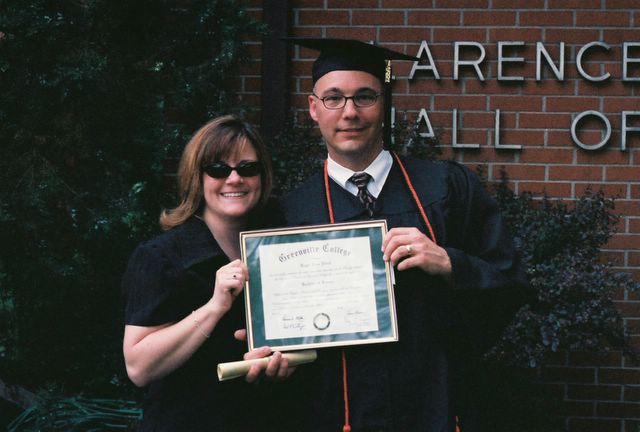
We've had a busy weekend! My graduation, #2's 8th birthday party and a fundraiser for Lindsey's foundation. Lot's of fun! Trish did a great job and a lot of hard work! Darrin and Penny's place is THE place to have an outdoor party. Jamie makes some mean margaritas! I'll try to post a couple of pics tomorrow.
Today. Cut grass and put in an air conditioning unit to keep the young'uns cool. Now I'm off to snuggle my love....see the last post....
Seems like change might be in the air for us...
Oh, yeah! Lots of conversations about hell. I'm not sure I'm really interested....but if you are here, here, here, and here. Much of this is in response to McClaren's new book.
I like this comment:
"The gospel, for McLaren, is about kingdom in the here and now and it is about a community wherein that kingdom vision has its way."
Today. Cut grass and put in an air conditioning unit to keep the young'uns cool. Now I'm off to snuggle my love....see the last post....
Seems like change might be in the air for us...
Oh, yeah! Lots of conversations about hell. I'm not sure I'm really interested....but if you are here, here, here, and here. Much of this is in response to McClaren's new book.
I like this comment:
"The gospel, for McLaren, is about kingdom in the here and now and it is about a community wherein that kingdom vision has its way."
Wednesday, May 18, 2005
Poll
Has your deepening relationship with God effected your sex-life?
This topic is for married adults, over age 21. I am not liable for the content in the comments of this post. Please read at your own risk.
This topic is for married adults, over age 21. I am not liable for the content in the comments of this post. Please read at your own risk.
Sunday, May 15, 2005
Celebrate good times, come on!
Bored at work? Try Guess-the-Google! Don't ask, just try it.
I walk the stage to get my diploma Saturday. It's kind of bitter-sweet for me. We had to sacrifice quite a bit for me to finish college, and the payoff has been less than spectacular. Don't get me wrong, I am glad that I finished, but our plans have changed so drastically since we first started this journey that the degree is not exactly helpful....who knows down the road.... Also, as if you didn't know this, I love to learn. I love ideas. So, in that way I miss school....
The good news is that we will be having a little graduation bash for some family and friends, coupled with #2 daughters birthday party! I really look forward to that! Let me run a quote by you that I heard the other day about celebration:
The Church doesn't really have anything to say to the world until we can throw better parties.
This got me thinking...How many church parties have I been to in organized religion? Let's see: I've been to some really exciting potlucks. . . I've eaten a few wild and crazy casseroles in my day. We just had National Day of Prayer at the town square. . .they did give away some free frozen custard (gotta have something for the bait and switch, right?). Our services are supposed to be a party. . . yawn. . .although I have been to some charismatic services where I swore some folks had been sippin' the sauce.
I don't think Jesus was afraid of a good party as I read it. And, he wasn't going to stuffy evangelical Christian parties either! He was turning water in to wine brotha! AFTER people were already getting soused! He was at the "sinner" parties. AND THEY LIKED HIM!
So, with that in mind, we are gonna have some fun to celebrate my graduation. A jumphouse sidewalk chalk, and squirt guns for the kiddos, adult beverages and washers for the adults (after a few adult beverages I may jump in the jumphouse too!), food, friends ...sounds like Kingdom Come to me!
I walk the stage to get my diploma Saturday. It's kind of bitter-sweet for me. We had to sacrifice quite a bit for me to finish college, and the payoff has been less than spectacular. Don't get me wrong, I am glad that I finished, but our plans have changed so drastically since we first started this journey that the degree is not exactly helpful....who knows down the road.... Also, as if you didn't know this, I love to learn. I love ideas. So, in that way I miss school....
The good news is that we will be having a little graduation bash for some family and friends, coupled with #2 daughters birthday party! I really look forward to that! Let me run a quote by you that I heard the other day about celebration:
The Church doesn't really have anything to say to the world until we can throw better parties.
This got me thinking...How many church parties have I been to in organized religion? Let's see: I've been to some really exciting potlucks. . . I've eaten a few wild and crazy casseroles in my day. We just had National Day of Prayer at the town square. . .they did give away some free frozen custard (gotta have something for the bait and switch, right?). Our services are supposed to be a party. . . yawn. . .although I have been to some charismatic services where I swore some folks had been sippin' the sauce.
I don't think Jesus was afraid of a good party as I read it. And, he wasn't going to stuffy evangelical Christian parties either! He was turning water in to wine brotha! AFTER people were already getting soused! He was at the "sinner" parties. AND THEY LIKED HIM!
So, with that in mind, we are gonna have some fun to celebrate my graduation. A jumphouse sidewalk chalk, and squirt guns for the kiddos, adult beverages and washers for the adults (after a few adult beverages I may jump in the jumphouse too!), food, friends ...sounds like Kingdom Come to me!
Thursday, May 12, 2005
Talents
In exploring my own presuppositions about the Bible I've discovered a few things.
Jesus is going to be gone a long time. He gave us all resources to use for His glory. We better use them wisely, for His glory, or we will be judged when He comes back.
This sounds like the typical interpretation I've heard around most churches. Sounds reasonable, and it's a good way to manipulate people into "kingdom work". The trouble is that it is totally wrong!
Instead of asking what these stories tell me, first I'm going to ask: How would the 1st Century Jew hear these stories? THEN I can ask what the story tells me and the Church.
The context: Jesus is leaving the Temple and talking to the disciples about the coming judgement that will fall on the Temple and it's system (Math. 24).
Historical Background: Israel has been under occupation for a long time. They are waiting for the Messiah who will restore the land, and redeem them from the captivity of the pagans. There is a general belief that the time is ripe for the Messiah to free Israel. Messianic fervor is common.
The important part of interpreting this text is that Jesus is Yahweh! Jesus is God. He has come to Israel in a time that they didn't expect and He is judging the religious system. The kingdom of Israel has failed it's mission : To be light to the world (Math 5:15-16), and bless all the families of the earth (Gen. 12:1-3). He is initiating His kingdom, which will be one of love, grace, justice, healing. . . A kingdom full of people who "turn the other cheek", "walk the extra mile", feed the hungry, comfort the stranger, accept the outcast, heal the sick, will be inclusive of all people. . . What has Israel done? Instead of blessing the world, they got hypnotized looking at their own bellybuttons. They turned inward. They kept the light for themselves. They turned what was meant for the world rules for entrance into a club.
Mat 21:43 Therefore I say to you, The kingdom of God shall be taken from you and given to a nation bringing out its fruits.
In this background Jesus tells the disciples the Parable of the Talents. Did he tell it to the Church? No. Did He tell it to me? No. He told it to a band of 1st Century Jewish followers who thought they were riding the coat-tails of the next Messiah. A group of guys who had no clue they were following Yahweh.
In this context, the parable takes on a different meaning. It was not about being faithful while Jesus was away, but that Israel was being judged. Israel was the third servant who had done nothing with what he had been given, and was now being judged by Yahweh in the flesh.
Does this parable have any meaning for the Church, or individuals within the Church? Yes. Can the Church, or the individuals who comprise the Church, be guilty of the same thing today? I would say that much of organized religion especially is guilty of looking at their own bellybutton instead of living in the Kingdom. I would say it is just as tempting to relegate the Kingdom to a "just God and me" mentality that also shuts out the world.
This is not as "pretty" of an interpretation as you might get elsewhere. It is not so applicable to "our circumstances". It is not about being ready for the return of Christ. It is not about living in fear that we have done enough. But, it is about judgement. The judgement of a religious system that was being judged by God in the flesh.
I challenge you to read Jesus' Parables with this context in mind. I believe they will begin to make more sense. . .
- I tend to read the Bible according to what it has to say TO ME, or the Church.
- I've interepreted much of what I've read with very little understanding of the history of Israel or the Jewish people.
- Because I have not understood the history of Israel, or the 1st Century Jewish worldview, I have tended to remove the NT writings from their original setting and tended toward "over-spiritualized" interpretations.
- I have totally misunderstood some of the narratives and teachings of Jesus because of numbers 1 and 2.
- If I've misunderstood the narratives and teachings of Jesus, there is a good chance I've misunderstood Jesus.
Jesus is going to be gone a long time. He gave us all resources to use for His glory. We better use them wisely, for His glory, or we will be judged when He comes back.
This sounds like the typical interpretation I've heard around most churches. Sounds reasonable, and it's a good way to manipulate people into "kingdom work". The trouble is that it is totally wrong!
Instead of asking what these stories tell me, first I'm going to ask: How would the 1st Century Jew hear these stories? THEN I can ask what the story tells me and the Church.
The context: Jesus is leaving the Temple and talking to the disciples about the coming judgement that will fall on the Temple and it's system (Math. 24).
Historical Background: Israel has been under occupation for a long time. They are waiting for the Messiah who will restore the land, and redeem them from the captivity of the pagans. There is a general belief that the time is ripe for the Messiah to free Israel. Messianic fervor is common.
The important part of interpreting this text is that Jesus is Yahweh! Jesus is God. He has come to Israel in a time that they didn't expect and He is judging the religious system. The kingdom of Israel has failed it's mission : To be light to the world (Math 5:15-16), and bless all the families of the earth (Gen. 12:1-3). He is initiating His kingdom, which will be one of love, grace, justice, healing. . . A kingdom full of people who "turn the other cheek", "walk the extra mile", feed the hungry, comfort the stranger, accept the outcast, heal the sick, will be inclusive of all people. . . What has Israel done? Instead of blessing the world, they got hypnotized looking at their own bellybuttons. They turned inward. They kept the light for themselves. They turned what was meant for the world rules for entrance into a club.
Mat 21:43 Therefore I say to you, The kingdom of God shall be taken from you and given to a nation bringing out its fruits.
In this background Jesus tells the disciples the Parable of the Talents. Did he tell it to the Church? No. Did He tell it to me? No. He told it to a band of 1st Century Jewish followers who thought they were riding the coat-tails of the next Messiah. A group of guys who had no clue they were following Yahweh.
In this context, the parable takes on a different meaning. It was not about being faithful while Jesus was away, but that Israel was being judged. Israel was the third servant who had done nothing with what he had been given, and was now being judged by Yahweh in the flesh.
Does this parable have any meaning for the Church, or individuals within the Church? Yes. Can the Church, or the individuals who comprise the Church, be guilty of the same thing today? I would say that much of organized religion especially is guilty of looking at their own bellybutton instead of living in the Kingdom. I would say it is just as tempting to relegate the Kingdom to a "just God and me" mentality that also shuts out the world.
This is not as "pretty" of an interpretation as you might get elsewhere. It is not so applicable to "our circumstances". It is not about being ready for the return of Christ. It is not about living in fear that we have done enough. But, it is about judgement. The judgement of a religious system that was being judged by God in the flesh.
I challenge you to read Jesus' Parables with this context in mind. I believe they will begin to make more sense. . .
Wednesday, May 11, 2005
The God Journey and our journey
The latest conversation at The God Journey is a gem, so give it a listen if you are interested in a non-threatening conversation about "what the church is".... Plus, my bride gets the last word!
We have been thinking about opening up a music store in our little town. Actually, our little town is becoming a medium town. We are taking some initial steps...putting the fleece out, as it were. I feel very at peace about it, which is rare for me when big decisions loom in the near future.
It is no secret that this night job is hard on me and on our family. We are not sure where the money for my student loan will come from, but it is time for me to quit. Last night, I stopped by a new restaraunt in town, Wings-To-Go, and it turns out one of the kid's Dad's from the latchkey program where I work, is co-owner. We got to talking and he is looking for an assistant manager type person and wanted to know if I knew anyone who was available.....hmmm....I like wings too!
I was hoping for some more conversation in my previous post....maybe I write to much....
We have been thinking about opening up a music store in our little town. Actually, our little town is becoming a medium town. We are taking some initial steps...putting the fleece out, as it were. I feel very at peace about it, which is rare for me when big decisions loom in the near future.
It is no secret that this night job is hard on me and on our family. We are not sure where the money for my student loan will come from, but it is time for me to quit. Last night, I stopped by a new restaraunt in town, Wings-To-Go, and it turns out one of the kid's Dad's from the latchkey program where I work, is co-owner. We got to talking and he is looking for an assistant manager type person and wanted to know if I knew anyone who was available.....hmmm....I like wings too!
I was hoping for some more conversation in my previous post....maybe I write to much....
Monday, May 09, 2005
The Future - Part 2
You might be wondering what any of this has to do with Jesus. I did just post some stuff about Jesus being central, right? Here’s my short answer: EVERYTHING! Christ is THE central figure in this Story. In fact, He is the beginning, middle and end.
In the beginning God created…it was good. Man decided to know good and evil outside of a relationship with the Creator and brought not only a curse on all mankind, but on all of creation (Gen. 3). God set apart a group of people, called Israel, through who God would heal the world. Instead of healing the world, Israel looked at their own bellybutton and “hid their light under a bowl”. God sent His Son, Jesus, to remind Israel of their purpose, redeem the world, and heal creation. Jesus passed His authority on to a new Israel; an Israel comprised of any race who would follow Him, the Church.
In this Five Act Story that we find ourselves in, we are left without a script. But, we have the previous four acts, and we have some clues to how the Story ends that will help us improvise in the meantime. One of the critical clues we have to help us improvise is now this Story will end. I seem to remember being taught in a business class: “Begin with the end in mind.” In this grand Story that is exactly what God has done. So, what if we started thinking about how this Story is going to end… Here is where I want to focus: All creation is in the process of being healed by the Creator and will culminate in a new heaven and new earth. (Rev. 21).
As I read this passage, it sounds like this should be something the Church is looking forward too. A place where God’ rule and reign are done perfectly. A place where everything that was broken, cursed and skewed in the Fall are healed, blessed and set straight in the new heaven and new earth. This is Good News! But, don’t think this is just some future event. “This world is not my home, I’m just a passin’ through”…NOOOO! Jesus said that His Gospel was: Mk 1:15 “The time is fulfilled, and the kingdom of God is at hand; repent and believe in the gospel.” The kingdom is here! The kingdom is now! Respond to it! Enter into it! Join the party!
What does Jesus do after he announces access to the kingdom? Jesus was enacting, and then explaining, the kingdom. He begins to cast out demons, give sight to the blind, heal the sick and lame… Why? Was he showing off his power? No! He was implementing this kingdom, which is now available to all who will choose it. He is giving a foretaste of the time when there will be no more death, or mourning, or crying, or pain! He is beginning the implementation of the new heaven and the new earth. Everything Jesus is doing is looking forward to the future.
Now let me put my personal experience, and belief system in this framework. For the past year or so God has been teaching me that this journey is about relationships. My relationship with Him, and my relationships with others. I will admit that my view has been centered around “me and God”, but I don’t think it stops there. If I stop there this whole kingdom project becomes about me. Much of the time, in practice, I act like the world revolves around me anyway, so it’s time for a course correction…. I think the Bible is clear that the Church is here as a little piece of the kingdom on Earth FOR THE SAKE OF THE WORLD.
The BIG STORY going on here is about God and world. It isn’t about the Law. It isn’t about you, and it isn’t about me. Our individual stories are incidental to the Big Story. It’s not that our stories don’t matter, they just need to be seen in light of the big picture. And the big picture is that God, through Jesus, is making all things new in the new heaven and new earth. Everything that went wrong in Eden is set right in the new Jerusalem (Rev. 21).
Does my personal, individual relationship with God matter? Yes! But not just to me. It matters to the world. Why? Because it is a foretaste of the time when Jer. 31:34
No longer shall they teach one another, or say to each other, "Know the Lord," for they shall all know me, from the least of them to the greatest, says the Lord; for I will forgive their iniquity, and remember their sin no more.
We’ve all read the “one anothers” in the Bible. Why are our relationships with each other in the Body so important? Because in the new heaven and new earth the consequences of sin are fully removed and true community will exist without the shame of the Fall. We will “cast aside our fig-leaves” and “live naked” before each other and God. Creation will be restored and renewed to the way God originally intended it. We, the Church, are a witness to the world that a new time is coming when that will be reality for everyone!
In this context my transformation into Christ-likeness takes on a new meaning. Sure, God wants me to be complete and whole. But, it is not just for my sake. It is so that those missing from the Family can witness the power of kingdom come. It is so the world can see that there will be a time when “everything is made new.”
Gathering. Hmmm. Here’s one where I’ve been stretched. What are the implications of how we gather in light of the now and future kingdom? Every nation, race, people and tongue will be represented. It’s a very “large gathering”. There is “corporate” worship going on... Does this kind of gathering have a message or purpose for the world?
Anyway, the bottom line is this: The Church exists for the sake of the world. We are a foretaste of the kingdom of God which will be fully revealed in the new heaven and new earth. We are a piece of the kingdom on earth, not just for our sake, for our healing, for our renewal, for our comfort, for our joy, but so the world can see kingdom now! As we improvise our part in the Story, we do so in light of the parts of the script we know, and our story becomes part of The Story...
What other implications do you see in our beliefs and practice in light of the Story?
In the beginning God created…it was good. Man decided to know good and evil outside of a relationship with the Creator and brought not only a curse on all mankind, but on all of creation (Gen. 3). God set apart a group of people, called Israel, through who God would heal the world. Instead of healing the world, Israel looked at their own bellybutton and “hid their light under a bowl”. God sent His Son, Jesus, to remind Israel of their purpose, redeem the world, and heal creation. Jesus passed His authority on to a new Israel; an Israel comprised of any race who would follow Him, the Church.
In this Five Act Story that we find ourselves in, we are left without a script. But, we have the previous four acts, and we have some clues to how the Story ends that will help us improvise in the meantime. One of the critical clues we have to help us improvise is now this Story will end. I seem to remember being taught in a business class: “Begin with the end in mind.” In this grand Story that is exactly what God has done. So, what if we started thinking about how this Story is going to end… Here is where I want to focus: All creation is in the process of being healed by the Creator and will culminate in a new heaven and new earth. (Rev. 21).
As I read this passage, it sounds like this should be something the Church is looking forward too. A place where God’ rule and reign are done perfectly. A place where everything that was broken, cursed and skewed in the Fall are healed, blessed and set straight in the new heaven and new earth. This is Good News! But, don’t think this is just some future event. “This world is not my home, I’m just a passin’ through”…NOOOO! Jesus said that His Gospel was: Mk 1:15 “The time is fulfilled, and the kingdom of God is at hand; repent and believe in the gospel.” The kingdom is here! The kingdom is now! Respond to it! Enter into it! Join the party!
What does Jesus do after he announces access to the kingdom? Jesus was enacting, and then explaining, the kingdom. He begins to cast out demons, give sight to the blind, heal the sick and lame… Why? Was he showing off his power? No! He was implementing this kingdom, which is now available to all who will choose it. He is giving a foretaste of the time when there will be no more death, or mourning, or crying, or pain! He is beginning the implementation of the new heaven and the new earth. Everything Jesus is doing is looking forward to the future.
Now let me put my personal experience, and belief system in this framework. For the past year or so God has been teaching me that this journey is about relationships. My relationship with Him, and my relationships with others. I will admit that my view has been centered around “me and God”, but I don’t think it stops there. If I stop there this whole kingdom project becomes about me. Much of the time, in practice, I act like the world revolves around me anyway, so it’s time for a course correction…. I think the Bible is clear that the Church is here as a little piece of the kingdom on Earth FOR THE SAKE OF THE WORLD.
The BIG STORY going on here is about God and world. It isn’t about the Law. It isn’t about you, and it isn’t about me. Our individual stories are incidental to the Big Story. It’s not that our stories don’t matter, they just need to be seen in light of the big picture. And the big picture is that God, through Jesus, is making all things new in the new heaven and new earth. Everything that went wrong in Eden is set right in the new Jerusalem (Rev. 21).
Does my personal, individual relationship with God matter? Yes! But not just to me. It matters to the world. Why? Because it is a foretaste of the time when Jer. 31:34
No longer shall they teach one another, or say to each other, "Know the Lord," for they shall all know me, from the least of them to the greatest, says the Lord; for I will forgive their iniquity, and remember their sin no more.
We’ve all read the “one anothers” in the Bible. Why are our relationships with each other in the Body so important? Because in the new heaven and new earth the consequences of sin are fully removed and true community will exist without the shame of the Fall. We will “cast aside our fig-leaves” and “live naked” before each other and God. Creation will be restored and renewed to the way God originally intended it. We, the Church, are a witness to the world that a new time is coming when that will be reality for everyone!
In this context my transformation into Christ-likeness takes on a new meaning. Sure, God wants me to be complete and whole. But, it is not just for my sake. It is so that those missing from the Family can witness the power of kingdom come. It is so the world can see that there will be a time when “everything is made new.”
Gathering. Hmmm. Here’s one where I’ve been stretched. What are the implications of how we gather in light of the now and future kingdom? Every nation, race, people and tongue will be represented. It’s a very “large gathering”. There is “corporate” worship going on... Does this kind of gathering have a message or purpose for the world?
Anyway, the bottom line is this: The Church exists for the sake of the world. We are a foretaste of the kingdom of God which will be fully revealed in the new heaven and new earth. We are a piece of the kingdom on earth, not just for our sake, for our healing, for our renewal, for our comfort, for our joy, but so the world can see kingdom now! As we improvise our part in the Story, we do so in light of the parts of the script we know, and our story becomes part of The Story...
What other implications do you see in our beliefs and practice in light of the Story?
Saturday, May 07, 2005
The Future Pt. 1 - God's Story
Before I get into what I really want to talk about I want to give some background. I hope you will read this and be patient. I think there is some very helpful stuff here about how we approach the Bible and the Gospel. I strongly encourage you to read the article. I'll get to the point in my next post. See if you don't resonate with this. . .
I've been giving some thought to how I look at the Bible and the Gospel. To be honest, many times when I read the Bible I am asking God to reveal Himself to me. Now, there is not necessarily anything wrong with that, but when I think that the any book of the Bible was written directly to me, for my benefit, I am quite likely to come up with interpretations that are askew. The fact is, the books of the Bible were not written to me, nor was their purpose to be for my benefit. They were written in a time that was much different from mine, to people in a TOTALLY different culture. If I don't take that into account I am likely to come up with some weird interpretations.
Couple this with the fact that the various ways that Modern theologians have used the Bible have not really been helpful. Systematic Theology has serious problems because it is rooted in a "scientific" way of summing up the Bible. Many scholars have their opinions and try to use proof-texts to back up their positions, taking verses totally out of context. Additionally, there are fundamentalists who believe that the Bible in itself has authority which leads to all kinds of abuse... Along comes N.T. Wright with a different way that Bible has authority.
Wright then asks, "Is the Bible a depository for 'timeless truth' "? That fact is, that the Bible is culturally conditioned. It was written to certain people at a certain time in history. It is not, and was never meant to be somewhere we go to find "particular answers to particular questions". When systematic theology divided the Bible into neat little chunks for easier consumption it is making the Bible into something it was never meant to be.
Wright points out that the more Evangelical churches say they are "Scripturally based", the more divided they become. "It seems to be the case that the more that you insist that you are based on the Bible, the more fissiparous you become; the church splits up into more and more little groups, each thinking that they have got biblical truth right."
To make a long article short, how do we read the Bible then? In what way does it have authority? Wright rightly points out that it is not the Bible that has authority, but God. Hooray! Finally a theologian that gets it!
And the notion of God’s authority, which we have to understand before we understand what we mean by the authority of the scripture, is based on the fact that this God is the loving, wise, creator, redeemer God. And his authority is his sovereign exercise of those powers; his love and wise creations and redemption. What is he doing? He is not simply organizing the world. He is, as we see and know in Christ and by the Spirit, judging and remaking the world. What he does authoritatively he does with this intent. God is not a celestial information service to whom you can apply for answers on difficult questions. Nor is he a heavenly ticket agency to whom you can go for moral and doctrinal permits or passports to salvation. He does not stand outside the human process and merely comment on it or merely issue you with certain tickets that you might need. Those views would imply either a deist’s God or a legalist’s God, not the God who is revealed in Jesus Christ and the Spirit. And it must be said that a great many views of biblical authority imply one or other of those sub-Christian alternatives.
But, once we say that God’s authority is like that, we find that there is a challenge issued to the world’s view of authority and to the church’s view of authority. Authority is not the power to control people, and crush them, and keep them in little boxes. The church often tries to do that – to tidy people up. Nor is the Bible, as the vehicle of God’s authority, meant to be information for the legalist. We have to apply some central reformation insights to the concept of authority itself. It seems to me that the Reformation, once more, did not go quite far enough in this respect, and was always in danger of picking up the mediaeval view of authority and simply continuing it with, as was often said, a paper pope instead of a human one. Rather, God’s authority vested in scripture is designed, as all God’s authority is designed, to liberate human beings, to judge and condemn evil and sin in the world in order to set people free to be fully human. That’s what God is in the business of doing. That is what his authority is there for. And when we use a shorthand phrase like “authority of scripture” that is what we ought to be meaning. It is an authority with this shape and character, this purpose and goal.
How, in the Bible, does God exercise his authority?
Then, we have to ask, if we are to get to the authority of scripture – How does God exercise that authority? Again and again, in the biblical story itself we see that he does so through human agents anointed and equipped by the Holy Spirit. And this is itself an expression of love, because he does not will simply to come into the world in a blinding flash of light and obliterate all opposition. He wants to reveal himself meaningfully within the space/time universe, not just passing it by tangentially; to reveal himself in judgment and in mercy in a way which will save people. So, we get the prophets. We get obedient writers in the Old Testament, not only prophets but those who wrote the psalms and so on. At the climax of the story we get Jesus himself as the great prophet, but how much more than a prophet. And, we then get Jesus’ people as the anointed ones.
To simplify Wrights view, the Bible is authoritative in that it is the Story of God. A five act play consisting of Act1: Creation, Act2: The Fall, Act3: Israel, Act:4 Jesus, Act5;Scene1: The New Testament, Act5;Scene2: Missing.
Suppose there exists a Shakespeare play whose fifth act had been lost. The first four acts provide, let us suppose, such a wealth of characterization, such a crescendo of excitement within the plot, that it is generally agreed that the play ought to be staged. Nevertheless, it is felt inappropriate actually to write a fifth act once and for all: it would freeze the play into one form, and commit Shakespeare as it were, to being prospectively responsible for work not in fact his own. Better, it might be felt, to give the key parts to highly trained, sensitive and experienced Shakespearian actors, who would immerse themselves in the first four acts, and in the language and culture of Shakespeare and his time, and who would then be told to work out a fifth act for themselves.
Wrights view is that we are actors in this play in which our "script" is missing. We have to improvise our part in this Story in light of what has happened before us, and the clues we have been given in how the Story will end. This frees us from being bogged down in the minutae of Modern exegesis and frees us to interpret the Story in the circumstances we find ourselves in today. Each generation must "implement" the Gospel for themselves, in their context, trying to be faithful to the Story. This view of authority does not seek to manipulate with power and control, or merely give information, but it is consistent with how Jesus used His authority during his time on Earth: telling stories.
That, in fact, is (I believe) one of the reasons why God has given us so much story, so much narrative in scripture. Story authority, as Jesus knew only too well, is the authority that really works. Throw a rule book at people’s heads, or offer them a list of doctrines, and they can duck or avoid it, or simply disagree and go away. Tell them a story, though, and you invite them to come into a different world; you invite them to share a world-view, or better still, a “God-view”. That, actually, is what the parables are all about. They offer, as all genuine Christian story-telling does, a world-view which, as someone comes into it and finds how compelling it is, quietly shatters the world-view that they were in already. Stories determine how people see themselves and how they see the world. Stories determine how they experience God and the world and themselves and others. Great revolutionary movements have told stories about the past and present and future. They have invited people to see themselves in that light, and people’s lives have been changed. If that happens at merely a human level, how much more when it is God himself, the creator, breathing through his word.
I've been giving some thought to how I look at the Bible and the Gospel. To be honest, many times when I read the Bible I am asking God to reveal Himself to me. Now, there is not necessarily anything wrong with that, but when I think that the any book of the Bible was written directly to me, for my benefit, I am quite likely to come up with interpretations that are askew. The fact is, the books of the Bible were not written to me, nor was their purpose to be for my benefit. They were written in a time that was much different from mine, to people in a TOTALLY different culture. If I don't take that into account I am likely to come up with some weird interpretations.
Couple this with the fact that the various ways that Modern theologians have used the Bible have not really been helpful. Systematic Theology has serious problems because it is rooted in a "scientific" way of summing up the Bible. Many scholars have their opinions and try to use proof-texts to back up their positions, taking verses totally out of context. Additionally, there are fundamentalists who believe that the Bible in itself has authority which leads to all kinds of abuse... Along comes N.T. Wright with a different way that Bible has authority.
When people in the church talk about authority they are very often talking about controlling people or situations. They want to make sure that everything is regulated properly, that the church does not go off the rails doctrinally or ethically, that correct ideas and practices are upheld and transmitted to the next generation. “Authority” is the place where we go to find out the correct answers to key questions such as these. This notion, however, runs into all kinds of problems when we apply it to the Bible. Is that really what the Bible is for? Is it there to control the church? Is it there simply to look up the correct answers to questions that we, for some reason, already know?
As we read the Bible we discover that the answer to these questions seems in fact to be
“no”.
As we read the Bible we discover that the answer to these questions seems in fact to be
“no”.
Wright then asks, "Is the Bible a depository for 'timeless truth' "? That fact is, that the Bible is culturally conditioned. It was written to certain people at a certain time in history. It is not, and was never meant to be somewhere we go to find "particular answers to particular questions". When systematic theology divided the Bible into neat little chunks for easier consumption it is making the Bible into something it was never meant to be.
Wright points out that the more Evangelical churches say they are "Scripturally based", the more divided they become. "It seems to be the case that the more that you insist that you are based on the Bible, the more fissiparous you become; the church splits up into more and more little groups, each thinking that they have got biblical truth right."
To make a long article short, how do we read the Bible then? In what way does it have authority? Wright rightly points out that it is not the Bible that has authority, but God. Hooray! Finally a theologian that gets it!
Beginning, though, with explicit scriptural evidence about authority itself, we find soon
enough – this is obvious but is often ignored – that all authority does indeed belong to God.“In the beginning, God created the heavens and the earth”. God says this, God says that, and it is done. Now, if that is not authoritative, I don’t know what is. God calls Abraham; hespeaks authoritatively. God exercises authority in great dynamic events (in Exodus, the Exile and Return). In the New Testament, we discover that authority is ultimately invested in Christ: “all authority has been given to me in heaven and on earth.” Then, perhaps to our
surprise, authority is invested in the apostles: Paul wrote whole letters in order to make thispoint crystal clear (in a manner of speaking). This authority, we discover, has to do with theHoly Spirit. And the whole church is then, and thereby, given authority to work within
God’s world as his accredited agent(s). From an exceedingly quick survey, we are forced tosay: authority, according to the Bible itself, is vested in God himself, Father, Son and Spirit.
enough – this is obvious but is often ignored – that all authority does indeed belong to God.“In the beginning, God created the heavens and the earth”. God says this, God says that, and it is done. Now, if that is not authoritative, I don’t know what is. God calls Abraham; hespeaks authoritatively. God exercises authority in great dynamic events (in Exodus, the Exile and Return). In the New Testament, we discover that authority is ultimately invested in Christ: “all authority has been given to me in heaven and on earth.” Then, perhaps to our
surprise, authority is invested in the apostles: Paul wrote whole letters in order to make thispoint crystal clear (in a manner of speaking). This authority, we discover, has to do with theHoly Spirit. And the whole church is then, and thereby, given authority to work within
God’s world as his accredited agent(s). From an exceedingly quick survey, we are forced tosay: authority, according to the Bible itself, is vested in God himself, Father, Son and Spirit.
And the notion of God’s authority, which we have to understand before we understand what we mean by the authority of the scripture, is based on the fact that this God is the loving, wise, creator, redeemer God. And his authority is his sovereign exercise of those powers; his love and wise creations and redemption. What is he doing? He is not simply organizing the world. He is, as we see and know in Christ and by the Spirit, judging and remaking the world. What he does authoritatively he does with this intent. God is not a celestial information service to whom you can apply for answers on difficult questions. Nor is he a heavenly ticket agency to whom you can go for moral and doctrinal permits or passports to salvation. He does not stand outside the human process and merely comment on it or merely issue you with certain tickets that you might need. Those views would imply either a deist’s God or a legalist’s God, not the God who is revealed in Jesus Christ and the Spirit. And it must be said that a great many views of biblical authority imply one or other of those sub-Christian alternatives.
But, once we say that God’s authority is like that, we find that there is a challenge issued to the world’s view of authority and to the church’s view of authority. Authority is not the power to control people, and crush them, and keep them in little boxes. The church often tries to do that – to tidy people up. Nor is the Bible, as the vehicle of God’s authority, meant to be information for the legalist. We have to apply some central reformation insights to the concept of authority itself. It seems to me that the Reformation, once more, did not go quite far enough in this respect, and was always in danger of picking up the mediaeval view of authority and simply continuing it with, as was often said, a paper pope instead of a human one. Rather, God’s authority vested in scripture is designed, as all God’s authority is designed, to liberate human beings, to judge and condemn evil and sin in the world in order to set people free to be fully human. That’s what God is in the business of doing. That is what his authority is there for. And when we use a shorthand phrase like “authority of scripture” that is what we ought to be meaning. It is an authority with this shape and character, this purpose and goal.
How, in the Bible, does God exercise his authority?
Then, we have to ask, if we are to get to the authority of scripture – How does God exercise that authority? Again and again, in the biblical story itself we see that he does so through human agents anointed and equipped by the Holy Spirit. And this is itself an expression of love, because he does not will simply to come into the world in a blinding flash of light and obliterate all opposition. He wants to reveal himself meaningfully within the space/time universe, not just passing it by tangentially; to reveal himself in judgment and in mercy in a way which will save people. So, we get the prophets. We get obedient writers in the Old Testament, not only prophets but those who wrote the psalms and so on. At the climax of the story we get Jesus himself as the great prophet, but how much more than a prophet. And, we then get Jesus’ people as the anointed ones.
To simplify Wrights view, the Bible is authoritative in that it is the Story of God. A five act play consisting of Act1: Creation, Act2: The Fall, Act3: Israel, Act:4 Jesus, Act5;Scene1: The New Testament, Act5;Scene2: Missing.
Suppose there exists a Shakespeare play whose fifth act had been lost. The first four acts provide, let us suppose, such a wealth of characterization, such a crescendo of excitement within the plot, that it is generally agreed that the play ought to be staged. Nevertheless, it is felt inappropriate actually to write a fifth act once and for all: it would freeze the play into one form, and commit Shakespeare as it were, to being prospectively responsible for work not in fact his own. Better, it might be felt, to give the key parts to highly trained, sensitive and experienced Shakespearian actors, who would immerse themselves in the first four acts, and in the language and culture of Shakespeare and his time, and who would then be told to work out a fifth act for themselves.
Wrights view is that we are actors in this play in which our "script" is missing. We have to improvise our part in this Story in light of what has happened before us, and the clues we have been given in how the Story will end. This frees us from being bogged down in the minutae of Modern exegesis and frees us to interpret the Story in the circumstances we find ourselves in today. Each generation must "implement" the Gospel for themselves, in their context, trying to be faithful to the Story. This view of authority does not seek to manipulate with power and control, or merely give information, but it is consistent with how Jesus used His authority during his time on Earth: telling stories.
That, in fact, is (I believe) one of the reasons why God has given us so much story, so much narrative in scripture. Story authority, as Jesus knew only too well, is the authority that really works. Throw a rule book at people’s heads, or offer them a list of doctrines, and they can duck or avoid it, or simply disagree and go away. Tell them a story, though, and you invite them to come into a different world; you invite them to share a world-view, or better still, a “God-view”. That, actually, is what the parables are all about. They offer, as all genuine Christian story-telling does, a world-view which, as someone comes into it and finds how compelling it is, quietly shatters the world-view that they were in already. Stories determine how people see themselves and how they see the world. Stories determine how they experience God and the world and themselves and others. Great revolutionary movements have told stories about the past and present and future. They have invited people to see themselves in that light, and people’s lives have been changed. If that happens at merely a human level, how much more when it is God himself, the creator, breathing through his word.

Thursday, May 05, 2005
Rumblings
I've been having some rumblings in my mind about some of the things that I've been learning over the past few years and how they integrate within God's Story. In a response to an excellent discussion on Matt's blog about the definition and sharing of the Gospel I started to process some of this. I just want to ask some questions and start some dialogue about this stuff and lets see what we come up with...
Should my faith, redemption, fellowship with God etc. have implications outside of myself? If so, what?
Does the Gospel have implications outside of the individual? In other words, is it all about "me and God" or does God have a wider purpose for the Gospel?
Does the Bible speak of a purpose for the Gospel other than my individual redemption and restoration of fellowship with Him?
What are the pros and cons of an "individualistic Gospel" and one that takes the world into view?
I look forward to hearing what you think....
I've been having some rumblings in my mind about some of the things that I've been learning over the past few years and how they integrate within God's Story. In a response to an excellent discussion on Matt's blog about the definition and sharing of the Gospel I started to process some of this. I just want to ask some questions and start some dialogue about this stuff and lets see what we come up with...
Should my faith, redemption, fellowship with God etc. have implications outside of myself? If so, what?
Does the Gospel have implications outside of the individual? In other words, is it all about "me and God" or does God have a wider purpose for the Gospel?
Does the Bible speak of a purpose for the Gospel other than my individual redemption and restoration of fellowship with Him?
What are the pros and cons of an "individualistic Gospel" and one that takes the world into view?
I look forward to hearing what you think....
Monday, May 02, 2005
I've been reading some N.T. Wright lately and have had my eyes open to lack of my understanding of the Hebrew/Israelite culture that colors my understanding of the Jesus narratives. Knowing the political, social and economic situations of the various groups that where in play definately gives a different meaning to some of the passages. Much more "political" in nature, considering all that was going on in Israel at the time.
For instance being a disciple (talmid) meant something quite different than what our western version means:
A talmid did not follow a rabbi as a student. They desired to gain the rabbi's knowledge, but for a greater goal-they wanted to become like the rabbi himself.
A talmid followed the rabbi everywhere-every day, and every hour of the day-often without knowing or asking where the rabbi was going. The talmid rarely left his rabbi's side for fear that he would miss a teachable moment. He watched the rabbi's every move, noting how he acted and thought about a variety of situations.
Talmidim trusted their rabbi completely. They were eager to hear the rabbi's teachings and they worked passionately to incorporate the rabbi's actions and words into their lives. The disciple's deepest desire was to follow his rabbi so closely that he would start to think and act like the rabbi himself.
Here is an interesting site: Follow The Rabbi
For instance being a disciple (talmid) meant something quite different than what our western version means:
A talmid did not follow a rabbi as a student. They desired to gain the rabbi's knowledge, but for a greater goal-they wanted to become like the rabbi himself.
A talmid followed the rabbi everywhere-every day, and every hour of the day-often without knowing or asking where the rabbi was going. The talmid rarely left his rabbi's side for fear that he would miss a teachable moment. He watched the rabbi's every move, noting how he acted and thought about a variety of situations.
Talmidim trusted their rabbi completely. They were eager to hear the rabbi's teachings and they worked passionately to incorporate the rabbi's actions and words into their lives. The disciple's deepest desire was to follow his rabbi so closely that he would start to think and act like the rabbi himself.
Here is an interesting site: Follow The Rabbi
Friday, April 29, 2005
Brokenhearted
I weep for some people today.
We have a church in our town that has a history of power struggles and church splits etc. I heard a few weeks ago that the youth pastor, who had been there for over 15 years, was leaving without knowing what he was going to do next. I thought, "Hmmm, God must be doing something in him." So we had lunch, and I found out he was going to start a new church. I was kind of disappointed really. I was hoping that God was showing him the answers don't lay in how we do church, as much as how we are the church. But, God is showing him some things none-the-less. . .
So, the next Sunday my daughter was asked to go to this AWANA thing by one of her friends. We let her go and she really enjoyed it. She is a Martha, so busyness is next to godliness for her. . .yes, we are teaching her otherwise. It also happened to be the second week that this new church met. We found out that the "elders" of this church were waiting at the door and asking the AWANA teachers if they had attended the "new church". If they said yes, they were immediately told to get their things and leave, they were "anti-Our Church". Now, these teachers have taught these classes all year and were not even allowed to say goodbye to the kids. Not to mention that some of these people have had relationships in the church for years.
How sad it is when loyalty for an organization is given more weight than relationships and love. My heart grieves for those hurt, and for those who are causing the hurt. My heart grieves for those who left to start the new church, and for those who remain at the old church. I wonder if either will find the freedom they search for?
My heart also grieves for a mother of friend of ours. They have been life-long Lutherans. Which means, in my experience anyway, that they don't know much about the Bible. Anyway, they went to a Amazing Facts conference. This guy is some scary shit! I checked out some teaching and his view of Law and Grace is so technical and convoluted I didn't know how to follow it. He has an answer for everything, which immediately raises my suspicion.
The sad part is that through his legalistic teaching, he has this family so scared they are going to hell for having church on Sunday instead of Saturday, that they are freaking out. This is their first exposure to the Bible really, and our friend is really concerned for their wellbeing, but she doesn't know how to help them either. It is so sad when people are manipulated by fear-based teaching: "Get it right, or go to hell!" I am glad that I know a God that is much more gentle than some of his supposed "teachers" are. . . Hopefully, we will have a chance to talk to them. We did send some other teachings on Law and Grace that they can read together.
But my heart still grieves for those manipulated by legalists. . .
I weep for some people today.
We have a church in our town that has a history of power struggles and church splits etc. I heard a few weeks ago that the youth pastor, who had been there for over 15 years, was leaving without knowing what he was going to do next. I thought, "Hmmm, God must be doing something in him." So we had lunch, and I found out he was going to start a new church. I was kind of disappointed really. I was hoping that God was showing him the answers don't lay in how we do church, as much as how we are the church. But, God is showing him some things none-the-less. . .
So, the next Sunday my daughter was asked to go to this AWANA thing by one of her friends. We let her go and she really enjoyed it. She is a Martha, so busyness is next to godliness for her. . .yes, we are teaching her otherwise. It also happened to be the second week that this new church met. We found out that the "elders" of this church were waiting at the door and asking the AWANA teachers if they had attended the "new church". If they said yes, they were immediately told to get their things and leave, they were "anti-Our Church". Now, these teachers have taught these classes all year and were not even allowed to say goodbye to the kids. Not to mention that some of these people have had relationships in the church for years.
How sad it is when loyalty for an organization is given more weight than relationships and love. My heart grieves for those hurt, and for those who are causing the hurt. My heart grieves for those who left to start the new church, and for those who remain at the old church. I wonder if either will find the freedom they search for?
My heart also grieves for a mother of friend of ours. They have been life-long Lutherans. Which means, in my experience anyway, that they don't know much about the Bible. Anyway, they went to a Amazing Facts conference. This guy is some scary shit! I checked out some teaching and his view of Law and Grace is so technical and convoluted I didn't know how to follow it. He has an answer for everything, which immediately raises my suspicion.
The sad part is that through his legalistic teaching, he has this family so scared they are going to hell for having church on Sunday instead of Saturday, that they are freaking out. This is their first exposure to the Bible really, and our friend is really concerned for their wellbeing, but she doesn't know how to help them either. It is so sad when people are manipulated by fear-based teaching: "Get it right, or go to hell!" I am glad that I know a God that is much more gentle than some of his supposed "teachers" are. . . Hopefully, we will have a chance to talk to them. We did send some other teachings on Law and Grace that they can read together.
But my heart still grieves for those manipulated by legalists. . .
Wednesday, April 27, 2005
Here is a part of a conversation that I had on Alan's blog regarding a critique of the "Emerging Church". I would love to hear your thoughts. . .
I will say this, hopefully with tones and words of love:
In my opinion, many leaders in the EC have over emphasized things like the role of the pastor/leader, community and liturgy. I think this over emphasis will, in the end, will sidetrack the “conversation” into becoming just another denomination/flavor of Christianity, rather than a dynamic, relational movement of the Spirit.
Additionally, I think, in general, the EC has not gone far enough in challenging the role of the pastor/leader. I believe you have merely accepted a revised version of the modern pastor that, in the end, slaps a “relational” label on the same power structure the modern church uses, and puts external expectations and obligations on people to conform. I found it interesting that Kevin Rain’s blog just today touched on an angle of leadership that may be a symptom of what I’m talking about. You see, I so agree with Kevin’s “corrective”, but I wonder if that will happen because earlier Kevin says,
“We don't have enough agenda for those we lead. . . As leaders we know where we want someone to be moving toward. We usually have the mind of Christ on this too.”
From my point of view that walks the razor’s edge between power, authority and manipulation, and the natural encouragement that flows from the pastor/elder/deacon (yes, I believe these terms are more interchangeable than we make them out to be). I mean, is it just me, or if I believe I have the mind of Christ for someone else will I start trying to make that person meet my expectations and obligations of what I perceive to be the “mind of Christ”. Why not let that person have his own “mind of Christ”? I think this problem stems for an over emphasis on the role of the leader/pastor, which should be, very simply, to serve.
If you want to focus specifically on liturgy, it reminds me of Isaiah where they were giving sacrifices and expecting that God was present because they were doing the ritual. That is no different than gathering a bunch of people together in a building and singing songs and expecting that God is present. The comfort and safety of religious rules and rituals are always easier then living in the tension of relationship. I believe Jesus made it clear that He isn’t interested in rituals, but relationship. This is why I think it is foolish to make rituals such a large part of our experience of God. He may be present in them today, but what about tomorrow? A liturgy may demand my attention for a fixed period of time, but a relationship is continuous and demands constant attention. Some might say that the ritual forms me even if God is not present in it. I might concur, but the forming may not be positive.
I guess that is part of why I don’t feel a part of the “emerging conversation”, because much of the conversation is about things that are peripheral to Christ. In my opinion of course.
As for examples of what I am talking about, just pick some links on the “emerging” lists and see what people are talking about. Chances are there isn’t a whole lot of wrestling with Scripture. But, people are very interested in liturgy as a means to connect with God, they are very interested in learning how to lead with little or no mention of the headship of Christ, and they are talking a lot about community. While these can all be good things, they can also be totally void of God.
I can just tell you what I see, given my point of view and experiences. I really don’t expect anyone to be changed by my opinion. I do appreciate the dialogue though. Unfortunately, I am working nights and have a sick kid to be with all day, so no rest for the wicked today. . .I probably won’t be able to post again today, but I will check back. Peace to all here!
I will say this, hopefully with tones and words of love:
In my opinion, many leaders in the EC have over emphasized things like the role of the pastor/leader, community and liturgy. I think this over emphasis will, in the end, will sidetrack the “conversation” into becoming just another denomination/flavor of Christianity, rather than a dynamic, relational movement of the Spirit.
Additionally, I think, in general, the EC has not gone far enough in challenging the role of the pastor/leader. I believe you have merely accepted a revised version of the modern pastor that, in the end, slaps a “relational” label on the same power structure the modern church uses, and puts external expectations and obligations on people to conform. I found it interesting that Kevin Rain’s blog just today touched on an angle of leadership that may be a symptom of what I’m talking about. You see, I so agree with Kevin’s “corrective”, but I wonder if that will happen because earlier Kevin says,
“We don't have enough agenda for those we lead. . . As leaders we know where we want someone to be moving toward. We usually have the mind of Christ on this too.”
From my point of view that walks the razor’s edge between power, authority and manipulation, and the natural encouragement that flows from the pastor/elder/deacon (yes, I believe these terms are more interchangeable than we make them out to be). I mean, is it just me, or if I believe I have the mind of Christ for someone else will I start trying to make that person meet my expectations and obligations of what I perceive to be the “mind of Christ”. Why not let that person have his own “mind of Christ”? I think this problem stems for an over emphasis on the role of the leader/pastor, which should be, very simply, to serve.
If you want to focus specifically on liturgy, it reminds me of Isaiah where they were giving sacrifices and expecting that God was present because they were doing the ritual. That is no different than gathering a bunch of people together in a building and singing songs and expecting that God is present. The comfort and safety of religious rules and rituals are always easier then living in the tension of relationship. I believe Jesus made it clear that He isn’t interested in rituals, but relationship. This is why I think it is foolish to make rituals such a large part of our experience of God. He may be present in them today, but what about tomorrow? A liturgy may demand my attention for a fixed period of time, but a relationship is continuous and demands constant attention. Some might say that the ritual forms me even if God is not present in it. I might concur, but the forming may not be positive.
I guess that is part of why I don’t feel a part of the “emerging conversation”, because much of the conversation is about things that are peripheral to Christ. In my opinion of course.
As for examples of what I am talking about, just pick some links on the “emerging” lists and see what people are talking about. Chances are there isn’t a whole lot of wrestling with Scripture. But, people are very interested in liturgy as a means to connect with God, they are very interested in learning how to lead with little or no mention of the headship of Christ, and they are talking a lot about community. While these can all be good things, they can also be totally void of God.
I can just tell you what I see, given my point of view and experiences. I really don’t expect anyone to be changed by my opinion. I do appreciate the dialogue though. Unfortunately, I am working nights and have a sick kid to be with all day, so no rest for the wicked today. . .I probably won’t be able to post again today, but I will check back. Peace to all here!
Saturday, April 23, 2005
Abba's Comfort
I posted on Nov. 3, 2003 regarding a dream I had about my Granny. My Granny was an awesome lady! She represents safety, comfort, and servanthood to me. She has been gone for going on two years now and I think about her from time to time, but nothing really emotional or anything.
Last night I had another vivid dream about her. I usually can't remember most of my dreams, so this in itself is unusual for me.
I don't know that the specific dream was really all that important. What was important was that I awoke at 1:30 feeling her presence and comfort. I had tears rolling down my cheeks as I awoke. I got and went to the couch to soak in what was going on, and God made it clear that it was not Granny comforing me, but Him. He let me know that He is with us on this journey, even when He feels distant, or chooses to remain silent. So, last night, with tears rolling down my cheeks I sat in the arms of Abba and was comforted. . .
2Co 1:3-5 Blessed be the God and Father of our Lord Jesus Christ! He is the Father of mercies and the God of all comfort, who comforts us in all our suffering, so that we may be able to comfort others in all their suffering, since we ourselves are being comforted by God. For just as Christ's sufferings overflow to us, so our comfort overflows through Christ.
I posted on Nov. 3, 2003 regarding a dream I had about my Granny. My Granny was an awesome lady! She represents safety, comfort, and servanthood to me. She has been gone for going on two years now and I think about her from time to time, but nothing really emotional or anything.
Last night I had another vivid dream about her. I usually can't remember most of my dreams, so this in itself is unusual for me.
I don't know that the specific dream was really all that important. What was important was that I awoke at 1:30 feeling her presence and comfort. I had tears rolling down my cheeks as I awoke. I got and went to the couch to soak in what was going on, and God made it clear that it was not Granny comforing me, but Him. He let me know that He is with us on this journey, even when He feels distant, or chooses to remain silent. So, last night, with tears rolling down my cheeks I sat in the arms of Abba and was comforted. . .
2Co 1:3-5 Blessed be the God and Father of our Lord Jesus Christ! He is the Father of mercies and the God of all comfort, who comforts us in all our suffering, so that we may be able to comfort others in all their suffering, since we ourselves are being comforted by God. For just as Christ's sufferings overflow to us, so our comfort overflows through Christ.
Monday, April 18, 2005
Stuuuuupid Cat!
Barna's Report for the Year
I mainly think this stuff is rubbish, but it is interesting in one way. . .
George Barna, who has overseen the measurement of these factors since the tracking process began in 1991, noted that religious change generally occurs at a glacial pace. “The meter hasn’t budged for most of the trends we have been following over these 15 years,” the researcher noted. “The only discernible increases have been in the number of unchurched adults, those who are participating in small groups or cell groups, and the percentage of born again Christians who share their faith with non-Christians. The decreases relate to church attendance, Sunday school involvement, the percentage of people who align with Catholicism, and the number who have a biblical view of God’s character. In general, predicting next year’s religious statistics is safer than foretelling whether the Cubs will win the World Series.”
Hmmm. . .no real change in 15 years. . .maybe the "evangelism" of the "Evangelicals" isn't working?
Barna's Report for the Year
I mainly think this stuff is rubbish, but it is interesting in one way. . .
George Barna, who has overseen the measurement of these factors since the tracking process began in 1991, noted that religious change generally occurs at a glacial pace. “The meter hasn’t budged for most of the trends we have been following over these 15 years,” the researcher noted. “The only discernible increases have been in the number of unchurched adults, those who are participating in small groups or cell groups, and the percentage of born again Christians who share their faith with non-Christians. The decreases relate to church attendance, Sunday school involvement, the percentage of people who align with Catholicism, and the number who have a biblical view of God’s character. In general, predicting next year’s religious statistics is safer than foretelling whether the Cubs will win the World Series.”
Hmmm. . .no real change in 15 years. . .maybe the "evangelism" of the "Evangelicals" isn't working?
Saturday, April 16, 2005
The Mystery of Christ in You
I’ve been doing some reading in Colossians as of late and God is moving and revealing Himself to me in some different ways. I was struck by something in the text.
Col 1:13-19 For He has delivered us from the power of darkness and has translated us into the kingdom of His dear Son; in whom we have redemption through His blood, the remission of sins. Who is the image of the invisible God, the First-born of all creation. For all things were created in Him, the things in the heavens, and the things on the earth, the visible and the invisible, whether thrones or dominions or principalities or powers, all things were created through Him and for Him. And He is before all things, and by Him all things consist. And He is the Head of the body, the church, who is the Beginning, the First-born from the dead, that He may be pre-eminent in all things. For it pleased the Father that in Him all fullness should dwell.
Reread this passage and notice how Paul keeps saying “all” in the text. Paul is saying that he is our center, our context, our core, our essence, our beginning and our end. . . our everything. He really doesn’t leave anything out, does he? Life for the Christian is found IN HIM. . .and just a few verses later, Paul states that the mystery of this whole deal is that He is IN US!
Col 1:26-27 the mystery which has been hidden from ages and from generations, but now has been revealed to His saints. For to them God would make known what are the riches of the glory of this mystery among the nations, which is Christ in you, the hope of glory. . .
That is good news! The One who is All In All lives in us! This is why we don’t need more of God, we need less of everything else. Recognizing His working in us, resting in the love he puts in us, cooperating as He is changing us into His image, letting everything we do spring from our union with Him, allowing His power to flow through us, ridding ourselves of those things that diminish Him in our eyes, and embracing those things that magnify Him in our eyes. . .this is the Christian life.
Now I have known that God's Spirit lives in me for a long time. But living in that reality is a totally different story. . . and the journey goes on. . .
I’ve been doing some reading in Colossians as of late and God is moving and revealing Himself to me in some different ways. I was struck by something in the text.
Col 1:13-19 For He has delivered us from the power of darkness and has translated us into the kingdom of His dear Son; in whom we have redemption through His blood, the remission of sins. Who is the image of the invisible God, the First-born of all creation. For all things were created in Him, the things in the heavens, and the things on the earth, the visible and the invisible, whether thrones or dominions or principalities or powers, all things were created through Him and for Him. And He is before all things, and by Him all things consist. And He is the Head of the body, the church, who is the Beginning, the First-born from the dead, that He may be pre-eminent in all things. For it pleased the Father that in Him all fullness should dwell.
Reread this passage and notice how Paul keeps saying “all” in the text. Paul is saying that he is our center, our context, our core, our essence, our beginning and our end. . . our everything. He really doesn’t leave anything out, does he? Life for the Christian is found IN HIM. . .and just a few verses later, Paul states that the mystery of this whole deal is that He is IN US!
Col 1:26-27 the mystery which has been hidden from ages and from generations, but now has been revealed to His saints. For to them God would make known what are the riches of the glory of this mystery among the nations, which is Christ in you, the hope of glory. . .
That is good news! The One who is All In All lives in us! This is why we don’t need more of God, we need less of everything else. Recognizing His working in us, resting in the love he puts in us, cooperating as He is changing us into His image, letting everything we do spring from our union with Him, allowing His power to flow through us, ridding ourselves of those things that diminish Him in our eyes, and embracing those things that magnify Him in our eyes. . .this is the Christian life.
Now I have known that God's Spirit lives in me for a long time. But living in that reality is a totally different story. . . and the journey goes on. . .
Wednesday, April 13, 2005
Universalism
I’ve been giving some thought to the doctrine of Universalism that some of my brothers in Christ are espousing. I decided to work out a few of the issues that I have in my flawed writing. Now, if you know me at all, you will know I am not a preacher of “hellfire and damnation” (in fact, I’m not a preacher at all). In fact, I think the typical Christian’s concept of hell is probably less than Biblical. While I believe that contemporary Christians have a diminished view of God’s love, I cannot accept Universalism as a natural consequence of that love.
Do I believe that God is love? Yep. Do I believe that necessarily limits God to being only love? No. Do I believe that I can even begin to understand the type of love that God is? Not really. I think there is a tendency to limit God’s essence to a type of love that my limited human mind can grasp.
The main issue that I have with the doctrine of Universalism is that it strips the Gospel of it’s relational and incarnational aspects. My understanding of the Universalist view is that the redeems all of mankind without mankind’s consent. In other words, God forces His love on mankind. In Fowler’s words:
He does not force His love on those that would like nothing to do with it. Without choice there is no faith-love relationship. In human terms, there is rape. God is not a rapist.
Fowler points out that “freedom of choice” is not the same as free-will. God is the only being with absolute free-will. He may choose to do what He wishes and is not bound by any single or primary character trait. Humans, on the other hand, have been granted freedom of choice which allows us “freely chosen relational participation in the inner love relations of the Trinity.” Additionally, Adam and Eve were created as “choosing creatures” it does not make sense to me that God would heal the damage of sin by forcing Himself upon us.
Universalism poses other problems when the relational context of the Gospel is taken into account. Jesus made it clear that he came to set us free to be fully human by allowing God to function through us for His glory. If Christianity were merely a religion, a set of defined rules and regulations, I could more easily buy Universalism, but it is not. If Jesus merely fulfilled a legal obligation on the cross to redeem humanity, I could more easily buy Universalism, but He did not. Christianity is relational at its core.
Salvation is Christ! Salvation is Jesus the Savior manifesting His life in a receptive individual. Christ in us is the hope of glory according to Col. 1:27! In Col. 3:4 Paul tells us that Christ is our life! 1Jo 5:11-12 tells us that “God has given to us everlasting life, and this life is in His Son. He who has the Son has life; he who does not have the Son of God does not have life.”
It is not just what Christ accomplished for us on the cross. Universalism allows for salvation outside of relationship. The Gospel is reduced to a satisfaction of a legal requirement that allows “all” people entrance into the presence of God, whether they desire it or not, and Jesus is reduced to a “get out of hell free card” that is jammed down humanity’s throat.
Some might say that our “freedom of choice” makes God appear weak, and that the Gospel now depends on our “works” to be effective. I disagree. A gift does not lose its worth if it is not accepted. Jesus did the work on the cross, accepting that work does not in any way diminish the efficacy or the beauty of the sacrifice.
Yes, God is reconciling “all things” to Himself.
Col 1:20 And through Him having made peace through the blood of His cross, it pleased the Father to reconcile all things to Himself through Him, whether the things on earth or the things in Heaven.
Wait a minute! Don’t stop there! Let’s keep reading!
Col 1:21-23 And you, who were once alienated and enemies in your mind by wicked works, yet now He has reconciled in the body of His flesh through death, to present you holy and without blemish, and without charge in His sight, if indeed you continue in the faith grounded and settled, and are not moved away from the hope of the gospel, which you have heard and which was proclaimed in all the creation under Heaven, of which I, Paul, became a minister...
Hmmm....”if”.....
2Co 5:17-21 So that if any one is in Christ, that one is a new creature; old things have passed away; behold, all things have become new. And all things are of God, who has reconciled us to Himself through Jesus Christ, and has given to us the ministry of reconciliation; whereas God was in Christ reconciling the world to Himself, not imputing their trespasses to them, and putting the word of reconciliation in us. Then we are ambassadors on behalf of Christ, as God exhorting through us, we beseech you on behalf of Christ, be reconciled to God. For He has made Him who knew no sin, to be sin for us, that we might become the righteousness of God in Him.
Why would Paul say “if anyone is in Christ” that they are a new creature? If the world has been reconciled then everyone should be a new creature. Why would Paul say that Christ has reconciled us in the past tense, then plead with the Corinthians to be reconciled? Maybe it is because God never changes, and we are the ones who must change by responding to God’s overture of love toward us?
The Good News is that salvation is available to all those who desire it in the person of Jesus Christ! Unfortunately, not everyone desires Him, and God will not force Himself on them.
Again, I'm sure my humble attempt at understanding this stuff is flawed. Just trying to figure it out with my limited intellect. . .
I’ve been giving some thought to the doctrine of Universalism that some of my brothers in Christ are espousing. I decided to work out a few of the issues that I have in my flawed writing. Now, if you know me at all, you will know I am not a preacher of “hellfire and damnation” (in fact, I’m not a preacher at all). In fact, I think the typical Christian’s concept of hell is probably less than Biblical. While I believe that contemporary Christians have a diminished view of God’s love, I cannot accept Universalism as a natural consequence of that love.
Do I believe that God is love? Yep. Do I believe that necessarily limits God to being only love? No. Do I believe that I can even begin to understand the type of love that God is? Not really. I think there is a tendency to limit God’s essence to a type of love that my limited human mind can grasp.
The main issue that I have with the doctrine of Universalism is that it strips the Gospel of it’s relational and incarnational aspects. My understanding of the Universalist view is that the redeems all of mankind without mankind’s consent. In other words, God forces His love on mankind. In Fowler’s words:
Any mechanical understanding of God’s love as a unilateral force deterministically and omnipotently imposed upon man by the “will of God” does violence to a proper understanding of God’s love. Relational love cannot be forced or coerced. On a human level this is called “rape,” and on the divine level such a unilateral determination to coerce man to participate in God’s love does violence to the genuine faith-love relationship that God intends by a freely chosen response and willingness of man to be intimately involved with Himself. Such a personal faith-love relationship is what God intended when He Self-limited His own sovereign omnipotence in order to grant man a genuine “freedom of choice” that allows a freely chosen relational participation in the inner love relations of the Trinity.
He does not force His love on those that would like nothing to do with it. Without choice there is no faith-love relationship. In human terms, there is rape. God is not a rapist.
Fowler points out that “freedom of choice” is not the same as free-will. God is the only being with absolute free-will. He may choose to do what He wishes and is not bound by any single or primary character trait. Humans, on the other hand, have been granted freedom of choice which allows us “freely chosen relational participation in the inner love relations of the Trinity.” Additionally, Adam and Eve were created as “choosing creatures” it does not make sense to me that God would heal the damage of sin by forcing Himself upon us.
Universalism poses other problems when the relational context of the Gospel is taken into account. Jesus made it clear that he came to set us free to be fully human by allowing God to function through us for His glory. If Christianity were merely a religion, a set of defined rules and regulations, I could more easily buy Universalism, but it is not. If Jesus merely fulfilled a legal obligation on the cross to redeem humanity, I could more easily buy Universalism, but He did not. Christianity is relational at its core.
Salvation is Christ! Salvation is Jesus the Savior manifesting His life in a receptive individual. Christ in us is the hope of glory according to Col. 1:27! In Col. 3:4 Paul tells us that Christ is our life! 1Jo 5:11-12 tells us that “God has given to us everlasting life, and this life is in His Son. He who has the Son has life; he who does not have the Son of God does not have life.”
It is not just what Christ accomplished for us on the cross. Universalism allows for salvation outside of relationship. The Gospel is reduced to a satisfaction of a legal requirement that allows “all” people entrance into the presence of God, whether they desire it or not, and Jesus is reduced to a “get out of hell free card” that is jammed down humanity’s throat.
Some might say that our “freedom of choice” makes God appear weak, and that the Gospel now depends on our “works” to be effective. I disagree. A gift does not lose its worth if it is not accepted. Jesus did the work on the cross, accepting that work does not in any way diminish the efficacy or the beauty of the sacrifice.
Yes, God is reconciling “all things” to Himself.
Col 1:20 And through Him having made peace through the blood of His cross, it pleased the Father to reconcile all things to Himself through Him, whether the things on earth or the things in Heaven.
Wait a minute! Don’t stop there! Let’s keep reading!
Col 1:21-23 And you, who were once alienated and enemies in your mind by wicked works, yet now He has reconciled in the body of His flesh through death, to present you holy and without blemish, and without charge in His sight, if indeed you continue in the faith grounded and settled, and are not moved away from the hope of the gospel, which you have heard and which was proclaimed in all the creation under Heaven, of which I, Paul, became a minister...
Hmmm....”if”.....
2Co 5:17-21 So that if any one is in Christ, that one is a new creature; old things have passed away; behold, all things have become new. And all things are of God, who has reconciled us to Himself through Jesus Christ, and has given to us the ministry of reconciliation; whereas God was in Christ reconciling the world to Himself, not imputing their trespasses to them, and putting the word of reconciliation in us. Then we are ambassadors on behalf of Christ, as God exhorting through us, we beseech you on behalf of Christ, be reconciled to God. For He has made Him who knew no sin, to be sin for us, that we might become the righteousness of God in Him.
Why would Paul say “if anyone is in Christ” that they are a new creature? If the world has been reconciled then everyone should be a new creature. Why would Paul say that Christ has reconciled us in the past tense, then plead with the Corinthians to be reconciled? Maybe it is because God never changes, and we are the ones who must change by responding to God’s overture of love toward us?
The Good News is that salvation is available to all those who desire it in the person of Jesus Christ! Unfortunately, not everyone desires Him, and God will not force Himself on them.
Again, I'm sure my humble attempt at understanding this stuff is flawed. Just trying to figure it out with my limited intellect. . .
Tuesday, April 12, 2005
A.W. Tozer from "The Pursuit of God"
I want deliberately to encourage this mighty longing after God. The lack of it has brought us to our present low estate. The stiff and wooden quality about our religious lives is a result of our lack of holy desire. Complacency is a deadly foe of all spiritual growth. Acute desire must be present or there will be no manifestation of Christ to His people. He waits to be wanted. Too bad that with many of us He waits so long, so very long, in vain.
Every age has its own characteristics. Right now we are in an age of religious complexity. The simplicity which is in Christ is rarely found among us. In its stead are programs, methods, organizations and a world of nervous activities which occupy time and attention but can never satisfy the longing of the heart. The shallowness of our inner experience, the hollowness of our worship, and that servile imitation of the world which marks our promotional methods all testify that we, in this day, know God only imperfectly, and the peace of God scarcely at all.
If we would find God amid all the religious externals we must first determine to find Him, and then proceed in the way of simplicity. Now as always God discovers Himself to "babes" and hides Himself in thick darkness from the wise and the prudent. We must simplify our approach to Him. We must strip down to essentials (and they will be found to be blessedly few). We must put away all effort to impress, and come with the guileless candor of childhood. If we do this, without doubt God will quickly respond.
When religion has said its last word, there is little that we need other than God Himself. The evil habit of seeking God-and effectively prevents us from finding God in full revelation. In the "and" lies our great woe. If we omit the "and" we shall soon find God, and in Him we shall find that for which we have all our lives been secretly longing.
We need not fear that in seeking God only we may narrow our lives or restrict the motions of our expanding hearts. The opposite is true. We can well afford to make God our All, to concentrate, to sacrifice the many for the One.
Wednesday, April 06, 2005
Will the Emerging Church Fully Emerge?
I happened across this article on Eddie’s site the other day. I remember starting on this journey about 5-years ago and coming across Present Testimony Ministry and not understanding where they were coming from. Times have changed…
I would like to make a few comments about the article entitled “Will the Emerging Church Fully Emerge?”. Let me say a few things upfront. When I first heard of the concept of the “emerging church” I was intrigued. I knew that my church experience was missing something and I am not one that is afraid to try new things. I was drawn to the concept of “house church”, missional Christianity, and the emphasis put on community. Yet, I have hesitated to call myself part of the “emerging conversation” for several reasons. I think it is time to flesh some of them out, and I’d like to use Frank Viola’s article as a starting point.
That said, I think that Frank has a fairly limited definition of what he considers an “emerging church” and I really don’t want to get caught up in all the fuzzy language that comes into play when trying to define what this emerging thing is. So if the shoe doesn’t fit, don’t put it on. I think the principles still apply. Please take some time and read the article. My comments are based on it, and you may misunderstand what I’m saying if you don’t read it first.
Frank applauds much of what the emerging church stands for, but I think his critiques are valid based on the many conversations and blogs that I participate in. I’m not going to address them all.
I don’t know exactly who are what Viola is critiquing here, but I agree that this always a danger. Let me say that I think one example is the emphasis that many emerging leaders put on liturgy. I was raised in the church. I haven’t experienced a whole lot of high-church, so I really don’t relate a whole lot to whole liturgy thing. I understand it is supposed to form us by forcing us to read through various portions of Scripture on a regular basis. I’ve tried it. I’ve even tried to enjoy it. I’ve tried to convince myself that it was good for me. I wanted to be like my emerging brothers and sisters who claim it connects them to Christ. I felt out of place and awkward because it just doesn’t work for me. I don’t buy the garbage that “we don’t know what is forming us” either. I know what connects me to Christ. I know what magnifies Christ in my eyes.
I think the issue is that an exploration of our internal relationship with Christ can express itself in a hundred different ways outwardly. It seems like that was one of our critiques of the modern church: One size fits all worship. Do it our way or no way. I fail to see how forcing a group of people to follow a liturgy is respectful of the myriad of ways that Christ expresses Himself in us and transforms us into His likeness.
The emerging church phenomenon has wonderfully articulated some of the major flaws of the modern church, yet like all of its predecessors, it has failed to identify and take dead aim at one of the chief roots of most of its ills. Namely, the modern pastoral office.
Frank points out that the modern concept of the pastoral office, and role of pastor, is fraught with issues.
My experience in this country and overseas over the last seventeen years has yielded one immovable conclusion: God’s people can engage in high-talk about community life, Body functioning, and Body life, but unless the modern pastoral role is utterly abandoned in a given church, God’s people will never be unleashed to function in freedom under the Headship of Jesus Christ. . . The reason is that the flaws of the modern pastoral role are actually built into the role itself.
Now we get to some meat and potatoes. The role of the pastor, and leadership in general, is talked about a lot in the emerging church scene. We seem to be very concerned about our role in the leadership of our churches. We talk about leading from “along side” instead in “the front.” We try to define the role of a pastor in such a way that avoids any appearance of the power-hungry people that many of us have served under in our institutional experiences. We go to great lengths to avoid any appearance of power or control.
I have wondered if the issue really isn’t how we define, or execute the role and office of pastor at all. Maybe we are still defining the role of pastor based on our modern assumptions and putting way to much emphasis on the function. Why is there so much discussion about OUR role as leaders, when it is really Jesus who is The Leader? How many discussions are having about the Headship of Christ? About how to help our friends know, see, hear and follow Jesus?
I’ll confess. I like to be needed. I like to feel like I am helping others. I like to feel like I am contributing to the spiritual health of my friends. The problem is that most of our friends are conditioned by modern assumptions what it means to “do church” too. They are very likely to rely on the pastor, no matter what the context, instead of the leading of Jesus.
Frank says, For the last seventeen years, I have been gathering with Christians outside the organized church. Without exception, all of the groups that I have gathered with or have worked with personally have known the pains and joys of community life in bed-rock reality, they have all had consistent meetings under the Lord’s Headship without a leader or facilitator, they have made decisions together, and they have solved their own problems . . . all without a pastor, or a group of selected men to rule them, and without a song leader or worship team.”
Is this possible? Groups of people dealing with pains and joys of community life, meeting consistently, making decisions, solving problems. . .all without a pastor? I think it is if we are putting Person of Jesus Christ at the center of all we do, and let him run the church as He sees fit.
Additionally, I don't think we are doing those we lead any favors by calling ourselves pastors. Read this article to find out some more information about church history and role and office of pastors. Warning! You may never look at your pastor the same. . .
The emerging church phenomenon, like all preceding reform/renewal movements, has emphasized a bundle of Christian “its” and “things,” instead of the Person of Jesus Christ.
In my opinion, if we were to examine the broad canvas of Christian movements and denominations throughout church history, we would discover that each one paints with a very fine brush. For one movement, the brush is evangelism. For another, it is social justice and acts of mercy. For another, it is praise and worship. For another, it is Bible study and doctrinal/theological accuracy. For another, it is the power of God, the gifts of the Spirit, signs and wonders. For another, it is changing the political system. For another, it is spiritual warfare and intercessory prayer. For another, it is personal prophecy. For still another, it is end-time theology (eschatology). And on and on it goes. All of these brushes represent Christian “things.” And they are just that . . . “things.” They are Christian “its.” Subjects about the Lord with which to become engaged, at best. Or with which to become obsessed, at worst.
This hits the nail on the head for me. I think Viola says something to those on the emerging journey that expresses what I’ve felt. For all the talk about community, community is not Christ. For all the talk about leadership, our leaders are not Christ. For all the talk about Postmodernism, it is not Christ. For all the talk about liturgy, liturgy is not Christ. For all the talk about our “contexts”, they are merely the expression of a group of individuals filled with Christ. Without Christ, our context means nothing.
My own critique inserted here is that we are much more likely to quote McLaren and Nouwen then we are Jesus. If you don’t believe me check your blogs.
In conclusion, I guess I don’t consider myself “emerging”. I think some of the people that consider themselves leaders in the emerging church are awesome people on a deep journey with God. But, I don’t care for some of the forms, rituals and obligations that those leaders espouse. The expression of the fullness of Christ that resides in me can express itself in any number of ways and I refuse to limit it by slapping a label on it. I am a Christ-follower. Plain and simple.
If some of this is incoherent, I apologize. Much was written at work in the middle of the night.... I look forward to wrestling through these issues. . .
I happened across this article on Eddie’s site the other day. I remember starting on this journey about 5-years ago and coming across Present Testimony Ministry and not understanding where they were coming from. Times have changed…
I would like to make a few comments about the article entitled “Will the Emerging Church Fully Emerge?”. Let me say a few things upfront. When I first heard of the concept of the “emerging church” I was intrigued. I knew that my church experience was missing something and I am not one that is afraid to try new things. I was drawn to the concept of “house church”, missional Christianity, and the emphasis put on community. Yet, I have hesitated to call myself part of the “emerging conversation” for several reasons. I think it is time to flesh some of them out, and I’d like to use Frank Viola’s article as a starting point.
That said, I think that Frank has a fairly limited definition of what he considers an “emerging church” and I really don’t want to get caught up in all the fuzzy language that comes into play when trying to define what this emerging thing is. So if the shoe doesn’t fit, don’t put it on. I think the principles still apply. Please take some time and read the article. My comments are based on it, and you may misunderstand what I’m saying if you don’t read it first.
Frank applauds much of what the emerging church stands for, but I think his critiques are valid based on the many conversations and blogs that I participate in. I’m not going to address them all.
While the emerging church phenomenon has placed a much needed emphasis on the Jesus of the Gospels, it has focused on imitating His outward conduct instead of exploring His internal relationship with an indwelling God which was the source of His conduct.
I don’t know exactly who are what Viola is critiquing here, but I agree that this always a danger. Let me say that I think one example is the emphasis that many emerging leaders put on liturgy. I was raised in the church. I haven’t experienced a whole lot of high-church, so I really don’t relate a whole lot to whole liturgy thing. I understand it is supposed to form us by forcing us to read through various portions of Scripture on a regular basis. I’ve tried it. I’ve even tried to enjoy it. I’ve tried to convince myself that it was good for me. I wanted to be like my emerging brothers and sisters who claim it connects them to Christ. I felt out of place and awkward because it just doesn’t work for me. I don’t buy the garbage that “we don’t know what is forming us” either. I know what connects me to Christ. I know what magnifies Christ in my eyes.
I think the issue is that an exploration of our internal relationship with Christ can express itself in a hundred different ways outwardly. It seems like that was one of our critiques of the modern church: One size fits all worship. Do it our way or no way. I fail to see how forcing a group of people to follow a liturgy is respectful of the myriad of ways that Christ expresses Himself in us and transforms us into His likeness.
The emerging church phenomenon has wonderfully articulated some of the major flaws of the modern church, yet like all of its predecessors, it has failed to identify and take dead aim at one of the chief roots of most of its ills. Namely, the modern pastoral office.
Frank points out that the modern concept of the pastoral office, and role of pastor, is fraught with issues.
My experience in this country and overseas over the last seventeen years has yielded one immovable conclusion: God’s people can engage in high-talk about community life, Body functioning, and Body life, but unless the modern pastoral role is utterly abandoned in a given church, God’s people will never be unleashed to function in freedom under the Headship of Jesus Christ. . . The reason is that the flaws of the modern pastoral role are actually built into the role itself.
Now we get to some meat and potatoes. The role of the pastor, and leadership in general, is talked about a lot in the emerging church scene. We seem to be very concerned about our role in the leadership of our churches. We talk about leading from “along side” instead in “the front.” We try to define the role of a pastor in such a way that avoids any appearance of the power-hungry people that many of us have served under in our institutional experiences. We go to great lengths to avoid any appearance of power or control.
I have wondered if the issue really isn’t how we define, or execute the role and office of pastor at all. Maybe we are still defining the role of pastor based on our modern assumptions and putting way to much emphasis on the function. Why is there so much discussion about OUR role as leaders, when it is really Jesus who is The Leader? How many discussions are having about the Headship of Christ? About how to help our friends know, see, hear and follow Jesus?
I’ll confess. I like to be needed. I like to feel like I am helping others. I like to feel like I am contributing to the spiritual health of my friends. The problem is that most of our friends are conditioned by modern assumptions what it means to “do church” too. They are very likely to rely on the pastor, no matter what the context, instead of the leading of Jesus.
Frank says, For the last seventeen years, I have been gathering with Christians outside the organized church. Without exception, all of the groups that I have gathered with or have worked with personally have known the pains and joys of community life in bed-rock reality, they have all had consistent meetings under the Lord’s Headship without a leader or facilitator, they have made decisions together, and they have solved their own problems . . . all without a pastor, or a group of selected men to rule them, and without a song leader or worship team.”
Is this possible? Groups of people dealing with pains and joys of community life, meeting consistently, making decisions, solving problems. . .all without a pastor? I think it is if we are putting Person of Jesus Christ at the center of all we do, and let him run the church as He sees fit.
Additionally, I don't think we are doing those we lead any favors by calling ourselves pastors. Read this article to find out some more information about church history and role and office of pastors. Warning! You may never look at your pastor the same. . .
The emerging church phenomenon, like all preceding reform/renewal movements, has emphasized a bundle of Christian “its” and “things,” instead of the Person of Jesus Christ.
In my opinion, if we were to examine the broad canvas of Christian movements and denominations throughout church history, we would discover that each one paints with a very fine brush. For one movement, the brush is evangelism. For another, it is social justice and acts of mercy. For another, it is praise and worship. For another, it is Bible study and doctrinal/theological accuracy. For another, it is the power of God, the gifts of the Spirit, signs and wonders. For another, it is changing the political system. For another, it is spiritual warfare and intercessory prayer. For another, it is personal prophecy. For still another, it is end-time theology (eschatology). And on and on it goes. All of these brushes represent Christian “things.” And they are just that . . . “things.” They are Christian “its.” Subjects about the Lord with which to become engaged, at best. Or with which to become obsessed, at worst.
This hits the nail on the head for me. I think Viola says something to those on the emerging journey that expresses what I’ve felt. For all the talk about community, community is not Christ. For all the talk about leadership, our leaders are not Christ. For all the talk about Postmodernism, it is not Christ. For all the talk about liturgy, liturgy is not Christ. For all the talk about our “contexts”, they are merely the expression of a group of individuals filled with Christ. Without Christ, our context means nothing.
My own critique inserted here is that we are much more likely to quote McLaren and Nouwen then we are Jesus. If you don’t believe me check your blogs.
In conclusion, I guess I don’t consider myself “emerging”. I think some of the people that consider themselves leaders in the emerging church are awesome people on a deep journey with God. But, I don’t care for some of the forms, rituals and obligations that those leaders espouse. The expression of the fullness of Christ that resides in me can express itself in any number of ways and I refuse to limit it by slapping a label on it. I am a Christ-follower. Plain and simple.
If some of this is incoherent, I apologize. Much was written at work in the middle of the night.... I look forward to wrestling through these issues. . .
Saturday, March 26, 2005
Prayer and Presence
Our gathering of misfits watched The Passion together last night. I was not really looking forward to it, but I think that our hearts were stirred as we took communion together immediately following the movie. Watching the movie from a perspective of what Jesus went through to break the power of sin out of his great love for us is quite different than watching it from the perspective of appeasement of God's wrath toward humanity. Did that make sense? If not, read He Loves Me by Wayne Jacobsen. He explains it far better than I. . .
I've been putting some thought into our journey recently. It's been a little while since we have been "unhooked from the Matrix." We are moving on from being critical of the Institutional Church to learning how to live the way that God has called us to: loved by Him, loving Him, and loving others, and letting the rest work itself out.
I need to confess that there are some things that left bad tastes in my mouth about organized religion that have caused me to react in ways that may not be positive. I think one example is prayer. I have been turned off by some of my charismatic brothers and sisters that over spiritualize every little thing in life and turn any difficulty into and attack by Satan. I have participated in praying for the sick that never got healed. I have prayed for and against circumstances that never worked out the way we were praying. (Looking back, there were many reasons why those prayers weren't answered. Don't want to go into it now.) So, I figured, screw it! I'll pray for the basics: God's will etc. But, I need to confess that I stopped praying with passion. I stopped praying with eager expectation. I was really paying God lip-service. . . and I thought this was part of my new journey.
As I begin to understand and live in the love God has for me I am learning to discern God's will in prayer. There is a spiritual realm where there is a battle going on, and prayer does affect it. I am asking God what He is doing. How does he want me to pray in certain situations? I am not taking for granted that God wants to heal somebody, or make a certain situations benefit my, or someone else's, self-interest.
God is active in His creation for the purpose of our redemption. He wants to transform humanity into His image and make us whole. He wants to see us free from sin. Can I pray those things for myself, for my friends and family, for my town, and eagerly expect God to answer? I think so. . .
If God is present in us, can we expect His power to flow through us? In the Naked Church, Wayne Jacobsen says, "We are a generation mostly won to Christ through the persuasion of orators, not the power of God's presence. Paul warned us that such people would have the inclination to put their trust in man's wisdom instead of God's power." What I get from that is talk is cheap. Intimacy is linked to God's power. So many people we come into contact with need the healing presence of Jesus. I have begun to see the fruit of God's presence in my life and His power flowing through me as people are being changed. I hope to see more as I continue to grow closer to Him. . .
Our gathering of misfits watched The Passion together last night. I was not really looking forward to it, but I think that our hearts were stirred as we took communion together immediately following the movie. Watching the movie from a perspective of what Jesus went through to break the power of sin out of his great love for us is quite different than watching it from the perspective of appeasement of God's wrath toward humanity. Did that make sense? If not, read He Loves Me by Wayne Jacobsen. He explains it far better than I. . .
I've been putting some thought into our journey recently. It's been a little while since we have been "unhooked from the Matrix." We are moving on from being critical of the Institutional Church to learning how to live the way that God has called us to: loved by Him, loving Him, and loving others, and letting the rest work itself out.
I need to confess that there are some things that left bad tastes in my mouth about organized religion that have caused me to react in ways that may not be positive. I think one example is prayer. I have been turned off by some of my charismatic brothers and sisters that over spiritualize every little thing in life and turn any difficulty into and attack by Satan. I have participated in praying for the sick that never got healed. I have prayed for and against circumstances that never worked out the way we were praying. (Looking back, there were many reasons why those prayers weren't answered. Don't want to go into it now.) So, I figured, screw it! I'll pray for the basics: God's will etc. But, I need to confess that I stopped praying with passion. I stopped praying with eager expectation. I was really paying God lip-service. . . and I thought this was part of my new journey.
As I begin to understand and live in the love God has for me I am learning to discern God's will in prayer. There is a spiritual realm where there is a battle going on, and prayer does affect it. I am asking God what He is doing. How does he want me to pray in certain situations? I am not taking for granted that God wants to heal somebody, or make a certain situations benefit my, or someone else's, self-interest.
God is active in His creation for the purpose of our redemption. He wants to transform humanity into His image and make us whole. He wants to see us free from sin. Can I pray those things for myself, for my friends and family, for my town, and eagerly expect God to answer? I think so. . .
If God is present in us, can we expect His power to flow through us? In the Naked Church, Wayne Jacobsen says, "We are a generation mostly won to Christ through the persuasion of orators, not the power of God's presence. Paul warned us that such people would have the inclination to put their trust in man's wisdom instead of God's power." What I get from that is talk is cheap. Intimacy is linked to God's power. So many people we come into contact with need the healing presence of Jesus. I have begun to see the fruit of God's presence in my life and His power flowing through me as people are being changed. I hope to see more as I continue to grow closer to Him. . .
Thursday, March 24, 2005
For those of our friends and family that would like to better understand this journey that God has us on take a listen to The God Journey. Wayne Jacobsen has been very influential in our journey and has a very loving way of explaining some of issues that we find important in living the life of God....
During some conversations with some brothers on a different blog I have really given some thought to our interpretation of the Bible. Especially the influence that bias and presuppositions have on our interpretation. I am no theology Nazi and I hold my interpretations fairly loosely. I have had to many experiences where I have found out my interpretations were flawed, or flat out BS.
For instance, when I first started following Jesus I was reading something like Mat 21:21
"Jesus answered and said to them, Truly I say to you, If you have faith and do not doubt, you shall not only do this miracle of the fig tree, but also; if you shall say to this mountain, Be moved and be thrown into the sea; it shall be done. "
I took this verse to mean that if we want to pray in effective ways that we MUST verbally speak our prayers. There were some other verses where Jesus says something similar, so I thought my interpretation was on strong grounds. . .until I told someone my interpretation. . .
We can look at the Bible through a hundred different lenses. If you are a music worship leader you will be able to find verses that make you think the core of the Bible is about worship. If you are passionate about helping the poor you will find enough verses for you to believe that the core of the Bible is about that. The bottom line is that our bias and presuppositions can drastically shape our interpretation of the Bible.
We really can't get rid of our bias and presuppositions. We are who we are. We were born in a certain nation, in a certain region, in a certain town. . . We all have had different religious experiences in different denominations. . . We all have had different family experiences, some healthy and some not so healthy. . .and all those circumstances influence how we read the Bible. For instance, isn't it interesting that European Christians typically don't believe in the rapture, yet it is a common belief among North American Christians?
Additionally, as we read the Bible we may be likely to give more weight to some parts of the Bible than others. We may choose to interpret the rest of the Bible through one our two verses that back up a certain position we hold. Our we may have certain beliefs about the nature of God that color our interpretations. Is God love? Is God just? Is He both?
So if we can't totally rid ourselves of bias and presupposition, how do we deal with them in order to move toward a better understanding of the Bible? I think the answer is to be self-critical of our bias and presuppositions. All of us have them. Most of the people that I discuss the Bible with are not even aware of them. Ignorance is bliss when it comes to presuppositions and bias. Once we realize that we have them we have to do the hard work of becoming aware as we read and interpret the text. We start asking questions like: Why do I interpret the text this way? What in my history biases me in this interpretation? What are the other possible interpretations? What were their presuppositions? If I change my presupposition can I see how it changes my interpretation? Am I willing to let others critique my interpretation? Am I willing to readdress my interpretation?
There are tons of other issues involved in this topic. The role of reason, sin, language, history etc. Understanding the Bible is a journey. As we gain knowledge, as we let God deal with and change our presuppositions, as we become conformed to God's image, as we interact and converse with others on this journey, we will gain a better understanding of the Bible and the story of God , of which we are part. . .
During some conversations with some brothers on a different blog I have really given some thought to our interpretation of the Bible. Especially the influence that bias and presuppositions have on our interpretation. I am no theology Nazi and I hold my interpretations fairly loosely. I have had to many experiences where I have found out my interpretations were flawed, or flat out BS.
For instance, when I first started following Jesus I was reading something like Mat 21:21
"Jesus answered and said to them, Truly I say to you, If you have faith and do not doubt, you shall not only do this miracle of the fig tree, but also; if you shall say to this mountain, Be moved and be thrown into the sea; it shall be done. "
I took this verse to mean that if we want to pray in effective ways that we MUST verbally speak our prayers. There were some other verses where Jesus says something similar, so I thought my interpretation was on strong grounds. . .until I told someone my interpretation. . .
We can look at the Bible through a hundred different lenses. If you are a music worship leader you will be able to find verses that make you think the core of the Bible is about worship. If you are passionate about helping the poor you will find enough verses for you to believe that the core of the Bible is about that. The bottom line is that our bias and presuppositions can drastically shape our interpretation of the Bible.
We really can't get rid of our bias and presuppositions. We are who we are. We were born in a certain nation, in a certain region, in a certain town. . . We all have had different religious experiences in different denominations. . . We all have had different family experiences, some healthy and some not so healthy. . .and all those circumstances influence how we read the Bible. For instance, isn't it interesting that European Christians typically don't believe in the rapture, yet it is a common belief among North American Christians?
Additionally, as we read the Bible we may be likely to give more weight to some parts of the Bible than others. We may choose to interpret the rest of the Bible through one our two verses that back up a certain position we hold. Our we may have certain beliefs about the nature of God that color our interpretations. Is God love? Is God just? Is He both?
So if we can't totally rid ourselves of bias and presupposition, how do we deal with them in order to move toward a better understanding of the Bible? I think the answer is to be self-critical of our bias and presuppositions. All of us have them. Most of the people that I discuss the Bible with are not even aware of them. Ignorance is bliss when it comes to presuppositions and bias. Once we realize that we have them we have to do the hard work of becoming aware as we read and interpret the text. We start asking questions like: Why do I interpret the text this way? What in my history biases me in this interpretation? What are the other possible interpretations? What were their presuppositions? If I change my presupposition can I see how it changes my interpretation? Am I willing to let others critique my interpretation? Am I willing to readdress my interpretation?
There are tons of other issues involved in this topic. The role of reason, sin, language, history etc. Understanding the Bible is a journey. As we gain knowledge, as we let God deal with and change our presuppositions, as we become conformed to God's image, as we interact and converse with others on this journey, we will gain a better understanding of the Bible and the story of God , of which we are part. . .
Thursday, March 17, 2005
I wholeheartedly apologize for my blog silence as of late. I have been working two part time jobs and filling in for another guy at my night job, which turns it into a full-time job. They have Blogger blocked, so I can't post or comment on other peoples sites either. I am reading yours though...just can't respond....
We see God working his way with some people around us. It is cool to see some of our prayers being answered! Our desire for freedom is increasing...as is our desire to see other's healed and set free....lots of stories but so little time....
Here are a few of my uncensored "prophetic" thoughts:
The time for God to pour out his presence in Highland is beginning. We have had occasional cool drops of water poured on our parched tongues, but now God wants to reveal His river to us…ever-flowing, satisfying, refreshing, powerful…
The time for human devised plans is over. God wants us to seek His heart, not just for Highland Hope, but all of Highland. What are His plans? How can we cooperate? What is our part? The time for church growth principles and financial campaigns has past. It is time to move in the Spirit and activate our faith. It is time to activate the supernatural that flows from our dynamic relationship with Abba.
We must pray against the spirit of religiosity and legalism that has infected Highland for many years. This is a spiritual battle that must be overcome by prayer. It will not be easily or quickly overcome. The root is very deep. Freedom is at stake. Fear of man is at the core.
Churches are situated to get the results that they are currently getting. Embrace change with eager expectations of what God is doing. S T R E T C H !
God is bringing inner healing to many who have been “walking wounded”. Spiritual warfare, intercession, unity, reconciliation, prophecy etc. will be more effective as God heals the inner hurts in His bride. God is going to release gifts, birthed from His power, fueled by His love, for nothing other than the purpose of making His Bride healthy.
We see God working his way with some people around us. It is cool to see some of our prayers being answered! Our desire for freedom is increasing...as is our desire to see other's healed and set free....lots of stories but so little time....
Here are a few of my uncensored "prophetic" thoughts:
The time for God to pour out his presence in Highland is beginning. We have had occasional cool drops of water poured on our parched tongues, but now God wants to reveal His river to us…ever-flowing, satisfying, refreshing, powerful…
The time for human devised plans is over. God wants us to seek His heart, not just for Highland Hope, but all of Highland. What are His plans? How can we cooperate? What is our part? The time for church growth principles and financial campaigns has past. It is time to move in the Spirit and activate our faith. It is time to activate the supernatural that flows from our dynamic relationship with Abba.
We must pray against the spirit of religiosity and legalism that has infected Highland for many years. This is a spiritual battle that must be overcome by prayer. It will not be easily or quickly overcome. The root is very deep. Freedom is at stake. Fear of man is at the core.
Churches are situated to get the results that they are currently getting. Embrace change with eager expectations of what God is doing. S T R E T C H !
God is bringing inner healing to many who have been “walking wounded”. Spiritual warfare, intercession, unity, reconciliation, prophecy etc. will be more effective as God heals the inner hurts in His bride. God is going to release gifts, birthed from His power, fueled by His love, for nothing other than the purpose of making His Bride healthy.
Tuesday, March 08, 2005
Movement
God has been at work in our little part of the world, not that he hasn’t been, but something different is happening. In my previous post, I mentioned my friend Rich. I am so blessed to have Rich for a friend. We have known each other since before either of us were Christ-followers, and it is amazing to see what God has done in our lives. Rich was blessed to find an awesome church family that has nourished his spirit, encouraged his spiritual gifts, and loved him into the presence of God.
Rich’s church is very charismatic. Most of the experiences that I’ve had with Charismatic churches have been uneasy at best. I’ve witnessed people so caught up in chasing religious experiences that it was like a drug. I’ve seen people do all kinds of crazy stuff in God’s name so I was skeptical when Rich started talking about what God was doing in his church. They have been helping people through sort through the crap in their lives and helping people get healed and set free by God. But the more we talked, the more it made sense. My background is with 12-step groups, so I’ve been through some of this stuff… Unfortunately, not many other Christians have….
Anyway, I was blessed to watch and assist several people deal with their past and lay it as the cross this week. People are getting free as they are dealing with unforgiveness, vows and judgements that have bound them for years. People in our little religious, legalistic town are tasting the freedom that only comes from having a relationship with God, and they want more. People are beginning to experience what we’ve only talked about until now. God is moving, and it is good….
I’ve got more to write, but no time at the moment...
God has been at work in our little part of the world, not that he hasn’t been, but something different is happening. In my previous post, I mentioned my friend Rich. I am so blessed to have Rich for a friend. We have known each other since before either of us were Christ-followers, and it is amazing to see what God has done in our lives. Rich was blessed to find an awesome church family that has nourished his spirit, encouraged his spiritual gifts, and loved him into the presence of God.
Rich’s church is very charismatic. Most of the experiences that I’ve had with Charismatic churches have been uneasy at best. I’ve witnessed people so caught up in chasing religious experiences that it was like a drug. I’ve seen people do all kinds of crazy stuff in God’s name so I was skeptical when Rich started talking about what God was doing in his church. They have been helping people through sort through the crap in their lives and helping people get healed and set free by God. But the more we talked, the more it made sense. My background is with 12-step groups, so I’ve been through some of this stuff… Unfortunately, not many other Christians have….
Anyway, I was blessed to watch and assist several people deal with their past and lay it as the cross this week. People are getting free as they are dealing with unforgiveness, vows and judgements that have bound them for years. People in our little religious, legalistic town are tasting the freedom that only comes from having a relationship with God, and they want more. People are beginning to experience what we’ve only talked about until now. God is moving, and it is good….
I’ve got more to write, but no time at the moment...
Wednesday, March 02, 2005
I apologize for the silence on the blog front. There have been some awesome things happening around here though!
First, my friend Rich, has been visiting us from England. God's Spirit moves mightily in him and he is a great encourager. Rich has reminded me of the passion that I used to have for Jesus, and how it has wained in the past few years. He has also reminded me that I cannot just keep giving and giving without being encouraged and filled by Jesus and those who passionately follow Him. God is doing some good things around here....I am encouraged for the first time, in a long time...
More to come....
First, my friend Rich, has been visiting us from England. God's Spirit moves mightily in him and he is a great encourager. Rich has reminded me of the passion that I used to have for Jesus, and how it has wained in the past few years. He has also reminded me that I cannot just keep giving and giving without being encouraged and filled by Jesus and those who passionately follow Him. God is doing some good things around here....I am encouraged for the first time, in a long time...
More to come....
Subscribe to:
Posts (Atom)